

Trade: the EU and India seal a vast agreement
The EU and India concluded their free trade agreement on 27 January 2026 after nearly twenty years of talks, creating a zone of 2 billion people and sharply cutting Indian duties on European cars, wines and agrifood products.
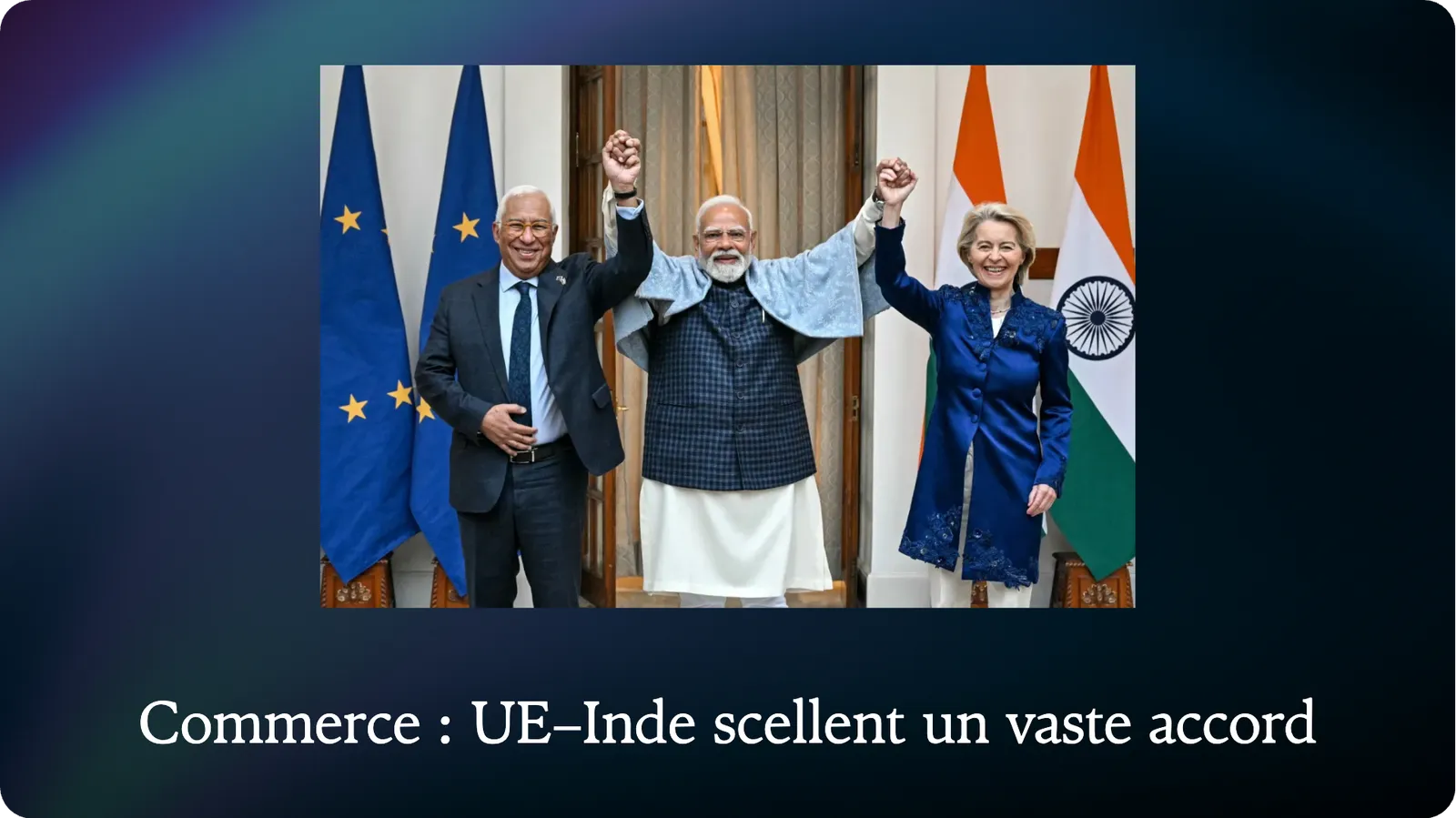
The European Union and India announced on 27 January 2026, in New Delhi, the conclusion of negotiations on their free trade agreement, after nearly two decades of talks. The agreement is set to create a free trade area of around 2 billion people, according to the PTI news agency as reported by The Week. This is not yet a formal signature: the text must go through legal scrubbing, translation and the approval procedures of both parties, with signature expected during 2026 and implementation likely in early 2027.
In a highly volatile geopolitical context, the agreement allows India and the Europeans to diversify their outlets in the face of Chinese competition and Donald Trump's tariff threats. In New Delhi, Ursula von der Leyen presented "the biggest trade deal ever concluded" by the European Union or by India, and a sign that a different way is possible in a fractured world, reports the Romanian news agency Agerpres. Prime Minister Narendra Modi sees it, according to The Week, as "a new model of shared prosperity".
What the agreement provides
The agreement sharply reduces Indian customs duties on most European imports. On the Indian side, duties are eliminated on 86% of tariff lines (93% by value); on the European side, on more than 90% of lines (91% by value), according to the European Commission. The main items:
- Cars: Indian duties will gradually fall from 110% to 10%, within annual quotas split by price bracket, according to Business Today.
- Wines: duties, which reach 150%, will fall to as low as 20% for premium wines, according to Agerpres; the Commission cites 30% for most wines and 40% for spirits over time.
- Pasta, chocolate, confectionery and other processed products: Indian duties (33% according to the Commission) will be removed, immediately or in stages; those on olive oil (up to 45%) will also disappear.
- Exclusions: India grants no concessions on dairy products, cereals or soya, while the EU protects sugar, beef and poultry.
According to Agerpres, European exporters could save up to 4 billion euros in customs duties per year. In 2024, trade in goods between the two partners reached 120 billion euros (49 billion in European exports, 71 billion in imports), according to the Commission.
What is at stake for India and for European companies
India, for its part, should use the agreement to attract the European investment it needs to modernise and to create millions of jobs for its population. Its exports will benefit from duty-free access for the vast majority of products, with the notable exception of cars and steel.
For European companies, the opening is real but gradual: car quotas, phase-out schedules over five to ten years and agricultural exclusions mean reasoning product by product. Rules of origin, sanitary standards and the protection of geographical indications (still under separate negotiation) will determine the actual gain.
What monitoring teams should watch
A concluded agreement is not an agreement in force. Geopolitical monitoring of EU-India relations and sector monitoring of your target markets help anticipate the next steps:
- The formal signature, then ratification by the Council and the European Parliament, and the date of entry into force.
- The publication of the final tariff schedules and of car quotas by price bracket.
- The rules of origin applicable to your products and to components imported from third countries.
- The outcome of the separate negotiations on geographical indications, decisive for wines and spirits.
- The reactions of Washington and Beijing, which could change the trade equation for supply chains running through India, to be built into supplier risk monitoring.
Sources
- The Week (PTI), India, EU conclude "mother of all deals" (2026)
- Agerpres, EC President Ursula von der Leyen: historic EU-India agreement shows a different way is possible (2026)
- European Commission, EU-India free trade agreement: chapter by chapter summary (2026)
- Business Today, Auto, wines, apples: India-EU FTA gives a gradual tariff reduction with import quota (2026)
Go deeper
All reportsThree NewsCore reports that build on this article.
- ID : NSC/ENER/0016
QatarEnergy, Cheniere, Venture Global, North Field expansion; Russian gas substitution.
€7,000Request - ID : NSC/PHRM/0019
Sun Pharma, Dr. Reddy's, Aurobindo, non-China API sourcing, US BIOSECURE Act and EU resilience.
€6,500Request - ID : NSC/PHRM/0020 · Window 3 months
Boom in China biotech deals (Akeso, BeiGene, LianBio) and M&A strategies under IRA pressure.
€6,500Request