

Mulliez family: the brands and model of the Mulliez group, a discreet dynasty
Auchan, Decathlon, Leroy Merlin, Kiabi, Boulanger: the Mulliez family brings together around 130 companies within the AFM. Governance, brands, verified figures and lessons for competitive intelligence.
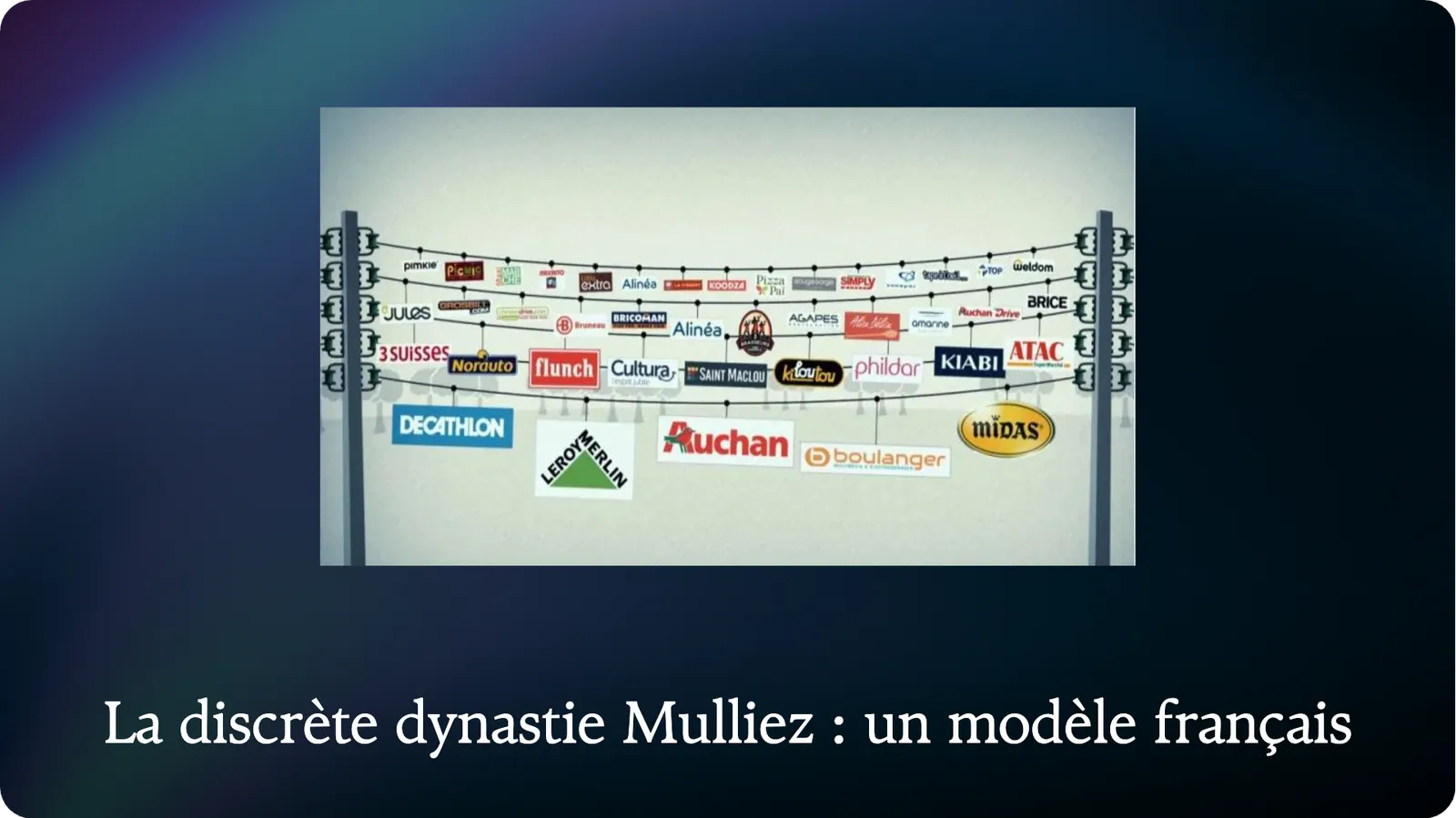
The Mulliez family is the entrepreneurial family from northern France behind Auchan, Decathlon, Leroy Merlin, Kiabi and Boulanger. Its roughly 950 members are brought together within the Association familiale Mulliez (AFM), which holds majority stakes in around 130 companies operating in more than 80 countries and employing more than 620,000 people. These figures were given under oath by the chairman of the AFM's management board before a committee of inquiry of the French Assemblée nationale in May 2025. People commonly speak of the "Mulliez group", but the family itself rejects the term. Here is where this discreet dynasty comes from, how it is governed, which retail brands make it up, how much they weigh, and what such a structure teaches those who do competitive intelligence.
Key takeaways
- Around 130 companies, more than 80 countries, more than 620,000 employees including nearly 175,000 in France, according to the AFM.
- The AFM is not a group in the legal sense: each brand is autonomous and no family member holds more than 10% of any company.
- For a competitor, a supplier or a landlord, tracking an unlisted family group relies on scattered public signals that must be cross-checked.
The Mulliez family: from Roubaix to a network of 130 companies
The story begins in 1905 in Roubaix, then the textile capital of the world. Industrialist Louis Mulliez built an entrepreneurial dynamic on two pillars: the autonomy of companies and solidarity among family members. From 1920 onward, he encouraged his sons and sons-in-law to start their own businesses, while organizing cross-shareholdings among them.
This vision gave rise to a federation of autonomous companies, founded or revived by descendants of Louis Mulliez. Auchan, created in 1961, is its historic flagship. Around it grew Decathlon, Leroy Merlin, Kiabi, Boulanger, Flunch and Jules, followed by activities further removed from retail. According to the AFM, some 40,000 employees live and work in northern France, where all the head offices are located.
The latest Challenges ranking of business fortunes places the Mulliez family 8th in France in 2025, down because of difficulties in retail, reports ABC Bourse.
The AFM: how the Mulliez group is governed
At the heart of the system is the Association familiale Mulliez. Its chairman insists on one point: "the AFM is not a group in the legal sense of the term". The companies in which the family holds majority stakes each have their own governance bodies and set their commercial and financial strategy on their own. There is no statutory financial solidarity between them.
The "All in all" principle
The founding rule is that each family member is a shareholder in all the companies, not just one. This principle, known as "Tous dans tout" ("All in all"), aligns interests and spreads risk: a struggling brand does not jeopardize the whole estate. According to IMD, family governance relies on a board elected by the shareholders, dedicated committees (training, family cohesion) and a council of elders tasked with preserving unity and the long-term vision.
The rules governing capital
- No member controls alone: no family partner holds more than 10% of the capital or voting rights of any company.
- Financial autonomy: the only rule imposed on all companies is independence from banks and markets.
- Reinvestment: according to the AFM, dividends paid to family partners represent 1% of the companies' value, and half of the value created is reinvested in the company that generated it.
- Employee share ownership: generalized in 1976, it covers more than 85% of employees in the ecosystem and represents nearly €4 billion in assets, again according to the AFM.
The AFM has some 950 members, spread across four generations. Its chairman told lawmakers that 112 partners, out of 1,229 descendants of Louis Mulliez, reside in Belgium, and that more than 80% of family partners are French tax residents.
The main brands of the Mulliez group
The AFM does not publish an exhaustive list of its holdings. The table below lists the brands and companies it cited itself before the Assemblée nationale, with verifiable figures.
| Brand | Sector | Verified figures |
|---|---|---|
| Auchan | Food retail | Founded in 1961; 12 countries, more than 2,300 stores and nearly 155,000 employees (Auchan Retail, 2025) |
| Decathlon | Sporting goods | Revenue of €16.2 billion in 2024, present in 79 territories |
| Leroy Merlin | DIY and home improvement | Nearly 15% of capital held by employee funds (AFM) |
| Kiabi | Low-price ready-to-wear | Revenue of €2.3 billion in 2024 (+5%) |
| Boulanger | Home appliances and consumer electronics | Recapitalized with €100 million (AFM) |
| Flunch | Restaurants | Recapitalized with €100 million (AFM) |
| Jules | Menswear | Founded or revived by a descendant of Louis Mulliez (AFM) |
| Foundever | Outsourced customer experience | Presented by the AFM as the world's number three in the sector |
| Voltalia | Renewable energy | Green energy producer (AFM) |
| Groupe Maisons de Famille | Nursing homes for the elderly | €105 million contributed by the AFM in 2024 |
How much do the Mulliez brands weigh?
In the absence of consolidated accounts, there is no official revenue figure for all the Mulliez brands combined: each company publishes (or does not publish) its own results. The largest ones nonetheless give an order of magnitude. Elo, Auchan's parent company, posted consolidated revenue of €32 billion in 2024 (+1.6%), including €31.7 billion for Auchan Retail, but recorded a net loss of €1.2 billion, according to Le Journal des Entreprises.
Decathlon reported revenue of €16.2 billion for 2024, up 5.2% at constant exchange rates, with 20% of sales made digitally. Kiabi announced revenue of €2.3 billion, up 5%, and record profitability. These gaps illustrate the logic of the model: the brands do not guarantee one another, but the family can reallocate its dividends. In October 2024, out of the €1 billion in reserves distributed by Decathlon, the AFM received €594 million, of which €266 million went to support Auchan, according to its chairman.
Mulliez brands in times of crisis: the Auchan example
The model offers no immunity against reversals. Before the same committee, the CEO of Auchan Retail acknowledged a continuous decline in store traffic for more than ten years, a market share in France that fell from 12.1% to 8% since 2012 and a net loss of €236 million in 2023, under pressure from hard discount and the decline of large hypermarkets. The job protection plan announced at the end of 2024 covers nearly 2,400 positions.
The family's response follows its doctrine: reinvest rather than sell. The AFM says it devoted €2 billion to reducing Auchan's debt five years ago, followed by a fresh contribution of €300 million. This is the flip side of "All in all": diversification of the estate makes it possible to support a brand through several difficult years.
What competitive intelligence learns from a family group
For a competitor, a supplier, a commercial landlord or a local authority, the Mulliez family is a textbook case. An unlisted, discreet structure without consolidated accounts escapes traditional financial analysis tools. Effective competitive intelligence then relies on a four-step method:
- Map the perimeter: identify the related companies, their executives and their shared directors, without assuming that a shared logo means a shared strategy.
- Collect scattered public sources: the brands' annual announcements, filed accounts, parliamentary hearings (such as the one in May 2025), wealth rankings, regional press in northern France.
- Track flows between entities: recapitalizations, distributions of reserves, disposals and acquisitions reveal the group's real priorities better than official statements do.
- Read sector signals: the hypermarket crisis affects Auchan, but also its suppliers, its landlords and the competitors picking up its customers.
These signals fall as much under economic monitoring (results, debt, employment) as under industry monitoring (store formats, hard discount, e-commerce). A job protection plan, store closures or a capital injection are not just news items: they are indicators of the balance of power in a market.
This is precisely what NewsCore automates. The platform continuously monitors tens of thousands of sources, national and regional press included, groups articles covering the same event, rates their severity and alerts the right decision-maker. Market intelligence teams can thus track a family group and each of its brands without reading hundreds of articles a week. To go further, our guide to market monitoring explains how to structure this tracking.
Frequently asked questions
Which companies belong to the Mulliez group?
According to the AFM, around 130 companies, including Auchan, Decathlon, Leroy Merlin, Kiabi, Boulanger, Flunch and Jules, but also Foundever (customer experience), Voltalia (renewable energy) and Groupe Maisons de Famille (nursing homes). They operate in more than 80 countries. The AFM does not publish an exhaustive list of its holdings, and some have changed hands over time.
What is the Association familiale Mulliez (AFM)?
It is the structure that brings together the roughly 950 shareholder members of the Mulliez family, descendants of Louis Mulliez. It is not a group in the legal sense: each company remains autonomous. It holds the family's stakes according to the "All in all" principle, under the direction of a management board chaired by Barthélemy Guislain.
How many brands does the Mulliez family own?
The AFM refers to around 130 companies, employing more than 620,000 people worldwide, including nearly 175,000 in France. This figure covers both large retail brands and companies in services, energy or healthcare. Press estimates vary depending on whether retail brands, legal entities or minority stakes are counted.
How wealthy is the Mulliez family?
The family does not publish this figure, and it is known only through press estimates. The 2025 Challenges ranking of business fortunes places the Mulliez family 8th in France, down because of difficulties in retail. This wealth is collective and shared among several hundred family partners, none of whom holds more than 10% of any company.
Is the Mulliez family listed on the stock market?
The AFM and its main retail brands, such as Auchan, Decathlon and Leroy Merlin, are not listed. The rule shared by the family's companies is financial independence from banks and markets, which explains the group's discretion and the scarcity of consolidated financial information.
Sources
- Assemblée nationale, commission d’enquête sur les défaillances des pouvoirs publics face aux plans de licenciements, audition d’Auchan Retail et de l’AFM, compte rendu n° 30 (2025)
- IMD, How the Mulliez family built a thriving entrepreneurial ecosystem (2026)
- Decathlon, communiqué de presse Performance du groupe Decathlon en 2024 (2025)
- Le Journal des Entreprises, Auchan Retail affiche un bilan contrasté pour 2024 (2025)
- Republik Retail, Pourquoi Kiabi a réalisé une année et une rentabilité records en 2024 (2025)
- ABC Bourse, Top 10 des plus grandes fortunes françaises en 2025 (2025)
Go deeper
All reportsThree NewsCore reports that build on this article.
- Private Label in European Mass Market RetailBest sellerID : NSC/RET/0016 · Window 1 month
Carrefour Bio, Marque Repère Leclerc, Casino, Aldi/Lidl all-private-label: premiumization.
€6,000Request - Creator Economy: Affiliation and InfluenceBest sellerID : NSC/RET/0003 · Window 12 months
YouTube Shopping, Instagram Shop, RewardStyle/LTK, Hauteur; unit economics and CAC.
€6,000Request - ID : NSC/RET/0005 · Window 1 month
Low-cost direct-from-China model, 2025 US tariffs, end of de minimis and EU strategies.
€6,500Request