

Syrian offensive: what future for the Kurds?
Deprived of support, the Kurdish SDF face a choice: integration or resistance against Damascus, depending on Syrian promises and their gains.
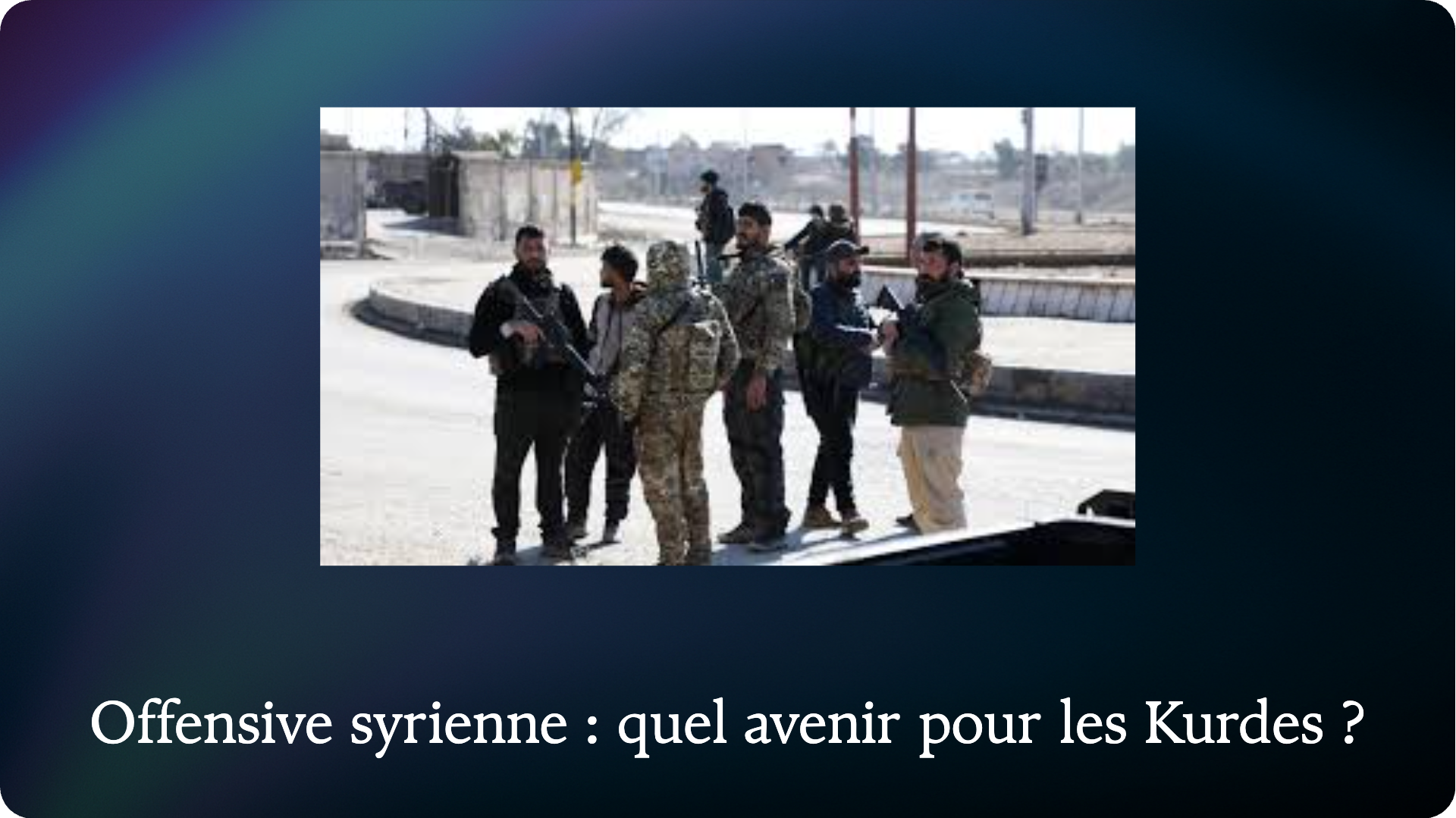
Within a few days, the forces of the new Syrian government have just reconquered almost all of the territories previously controlled by the Syrian Democratic Forces (SDF). This offensive comes after the SDF''s failure to integrate the new Syrian institutions set up by the interim president Ahmed al-Sharaa, in office since the fall of Bashar al-Assad''s regime in December 2024.
Kurdish territories can now only rely on a few strongholds : the Kobani pocket and a strip of territory in the north-east articulated around Tell Tamer, Hasakah and Qamishli. The fall of Tabqa on 18 January, quickly followed by Raqqa and the areas east of Deir ez-Zor and the Euphrates, means the loss of territories including the country''s main oil and gas fields, already brought back into operation by Damascus, as well as significant agricultural resources. The attack was facilitated by several converging factors: the erosion of international and local support for the SDF, the official end of US backing enacted by a US-Syrian agreement, Turkish military support for Damascus, and guarantees of non-intervention from the United States and Israel.
Faced with an unfavourable balance of power, the SDF have largely retreated, abandoning without significant resistance the Arab areas that are difficult to defend. The demotivation of Kurdish fighters is heightened by the latest political promises made by Ahmed al-Sharaa : cultural recognition, the naturalisation of thousands of Kurds, and the inclusion of Kurdish as one of the country''s official languages are all measures that were unthinkable under the Baathist era.
Deprived of allies, the Kurds ultimately find themselves facing a crucial strategic choice: accept integration and give up more than a decade of autonomy, or refuse and expose themselves to a new, potentially decisive and deadly offensive. The future of the Kurdish question now depends on Damascus respecting its commitments and on the SDF''s ability to preserve their gains within a recentralised Syrian state.
Go deeper
All reportsThree NewsCore reports that build on this article.
- ID : NSC/PHRM/0011 · Window 3 months
Casgevy, Lenmeldy, Skysona, Hemgenix: financing models, outcome-based payment and access exclusions.
€7,500Request - ID : NSC/AERO/0002
Mapping of the LEO race across Starlink, Kuiper, OneWeb, IRIS² and Chinese competitors (Guowang, Qianfan).
€7,000Request - ID : NSC/ENER/0001 · Window 3 months
127+ designs, 7 under construction, 51 in licensing across 15 countries; LCOE $90-160/MWh, AI data center demand.
€7,500Request