

Naval Group and Thales: Toward a Sovereign Naval AI
Naval Group is taking 20% of cortAIx France, Thales's AI accelerator, to develop a sovereign naval artificial intelligence in support of the armed forces.
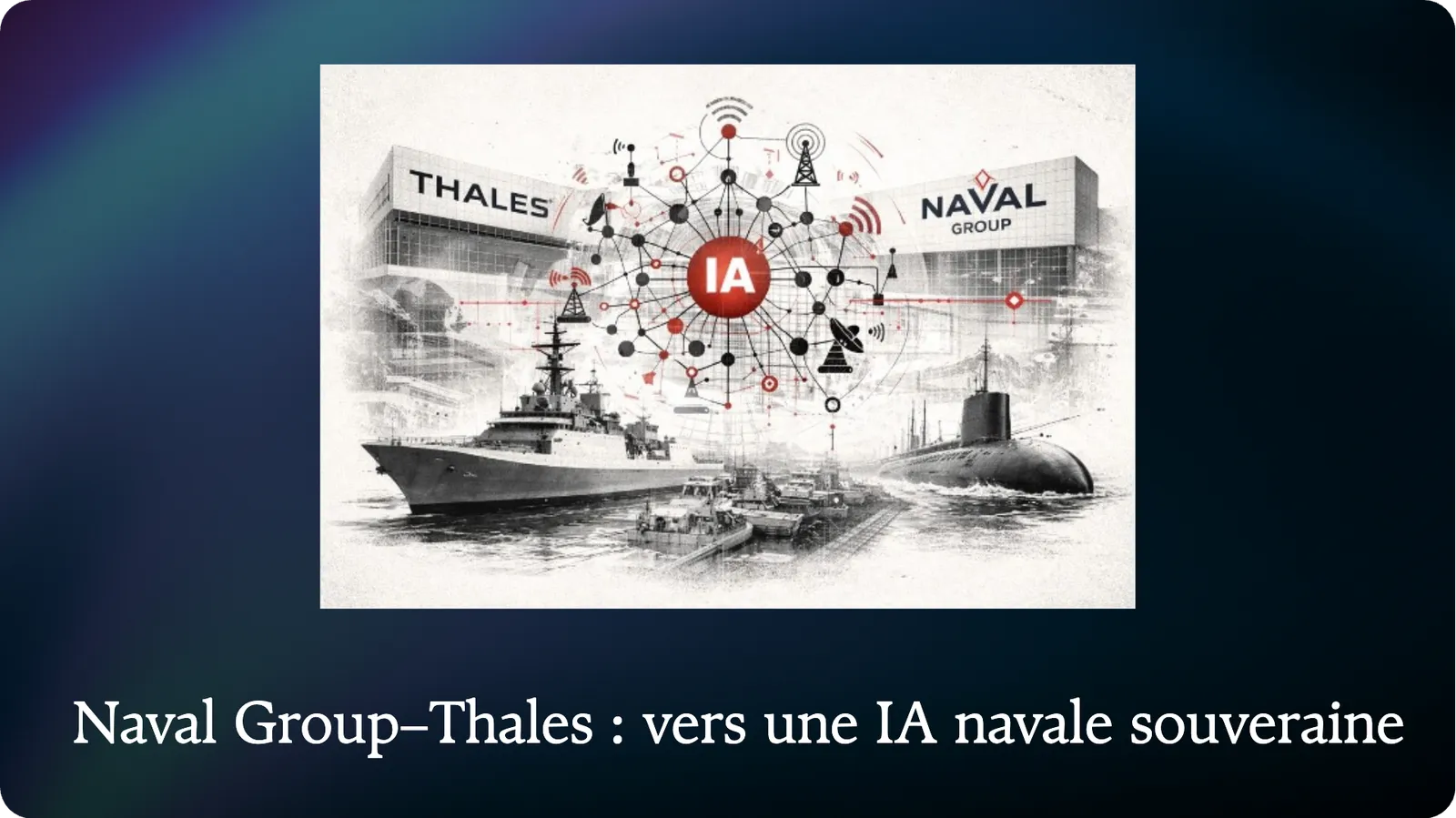
On February 10, 2026, Naval Group and Thales announced a strategic partnership around cortAIx France, Thales's artificial intelligence accelerator dedicated to critical systems. Naval Group is taking a 20% stake in this entity and joining its governance, according to the Thales press release. The stated goal: to rapidly provide the armed forces with trusted, cybersecure and sovereign AI solutions, while keeping humans at the heart of decisions.
The partnership comes with the opening of a dedicated center in the south of France, near a Naval Group site. The naval company's AI experts, notably those from its Digital Excellence Centre in Ollioules (Var), will strengthen the cortAIx France teams with their knowledge of the maritime environment, states the press release as reported by Aeromorning. The joint venture is meant to accelerate the industrialization of AI solutions applied to defense systems, while guaranteeing the sovereignty of the algorithms and the protection of sensitive data.
cortAIx, Thales's AI platform
Launched by Thales in 2024, the cortAIx initiative brings together more than 800 artificial intelligence experts across five hubs: France, the United Kingdom, Canada, Singapore and Germany. Thales says it has integrated AI into more than 100 of its products and presents itself as Europe's leading filer of patents for AI applied to critical systems over the past decade, reports Naval News.
Pierre Éric Pommellet, CEO of Naval Group, advocates a "sovereign and controlled" AI in tomorrow's naval warfare; Patrice Caine, CEO of Thales, stresses integrating AI into critical systems while keeping humans in control, according to Naval News.
Target use cases
The partners cite five application areas, detailed by Naval News:
- collaborative combat, with the management of multiple systems and support for observation and surveillance;
- decision support, through rapid analysis of large volumes of strategic, tactical and operational data;
- electronic warfare, with the automation of signal identification, radar geolocation and report writing;
- training and simulation, with adaptive scenarios and post-exercise analysis;
- logistics and support, to anticipate operational needs.
Why this alliance matters
The agreement addresses a well-identified constraint in defense: an algorithm fitted to a naval combat system must be auditable, updatable and protected without depending on a foreign supplier. By pooling their teams, the two companies reduce the risk of developing two competing building blocks for the same ships, one designing the ships, the other a broad range of sensors and systems.
For the industry, the partnership also sets a method: rather than multiplying in-house labs, prime contractors are pooling their scarce skills (security-cleared AI engineers, operational data) in a shared structure. SMEs and startups developing defense AI building blocks will have to deal with this new counterpart, at once a potential customer and a competitor.
What is at stake for businesses
For shipbuilding subcontractors, embedded AI translates into new requirements: data quality and traceability, cybersecurity of software supply chains, and the ability to integrate updates over the ship's service life. For Naval Group's export customers, the sovereignty argument may carry weight in tenders, provided the solutions are transferable and maintained over time.
What monitoring teams should watch
- The first cortAIx France deliveries integrated into naval programs (frigates, submarines, naval drones) and their timeline.
- Hiring and the actual opening of the Var center, concrete indicators of the ramp-up.
- The possible arrival of other companies in the capital of cortAIx France, or comparable structures at other European prime contractors.
- European and national texts governing the use of AI in weapon systems, which determine the scope of use cases.
Our guide to media monitoring in the defense sector describes how to structure this tracking, and our guide to technology monitoring helps map competing AI building blocks. See also our page dedicated to the defense industry.
Sources
Go deeper
All reportsThree NewsCore reports that build on this article.
- ID : NSC/DEF/0013 · Window 1 month
NIST PQC, EU programmes, quantum sensors, QKD communications and threats to critical infrastructure.
€7,500Request - ID : NSC/DEF/0003 · Window 3 months
Lasers, active radars, jamming, low-cost interceptors: Skyranger, Coyote, ELI/MS, MARSS.
€6,500Request - ID : NSC/DEF/0019
Franco-German-Spanish FCAS and UK-Italian-Japanese GCAP programmes: structure, timeline, export prospects.
€7,500Request