

Music Catalogs: A New Strategic Asset
Music catalogs are turning into prized financial assets, attracting investors with steady returns and reshaping cultural sovereignty.
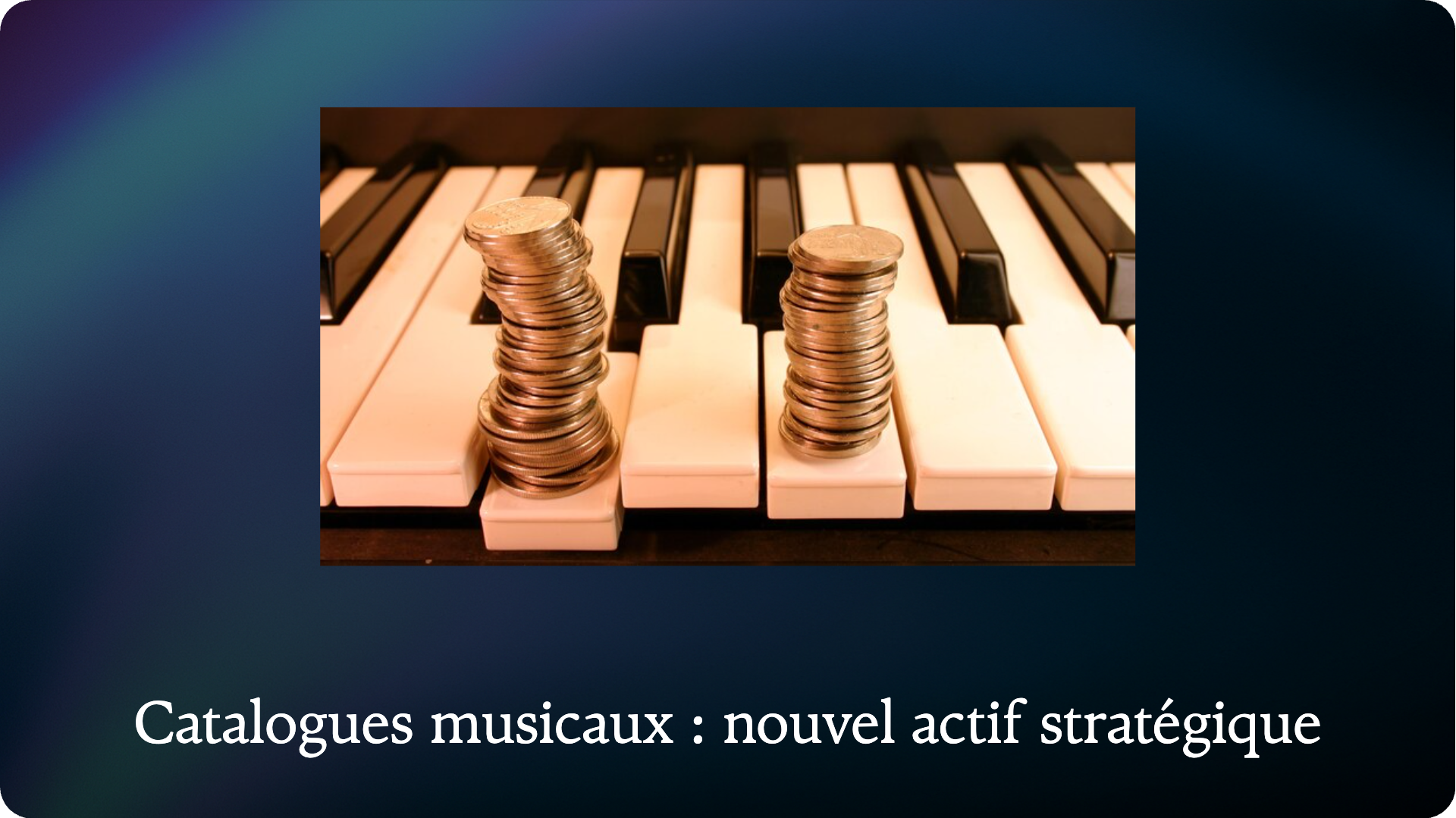
Records are no longer gold; today, it is catalogs that are worth diamonds.
Already shaken by the digital revolution, which had transformed the way music is distributed and consumed, a new phenomenon is emerging in the music industry: the massive entry of financial players into the acquisition of music catalogs.
Shifting business models and the financialization of catalogs.
Recently, the acquisition of music catalogs has been at the center of the news, with transactions reaching millions of dollars, creating a genuine parallel economy of music. In 2020, Bob Dylan sold his entire catalog to Universal Music Publishing Group for 150 million dollars. With the continuous expansion of the music economy, the valuation of catalogs is increasing. Music is no longer just a cultural industry but an investment in strategic intangible financial assets that are highly disputed. Behind this gold rush lies a race for control over cultural heritage. How did music, which used to be a simple cultural good, become a strategic asset at the center of new economic battles? To understand this shift in the industry, we will examine the phenomenon, its geopolitical and cultural impact, and its future strategies.
A music catalog gathers all the rights associated with works or recordings. It includes two types of catalogs: the publishing catalog, which concerns composition and falls under copyright, and the recording (masters) catalog, which falls under neighboring rights. Any holder of these rights decides on authorized uses (broadcasting, streaming) through collective management organizations and, in return, receives royalties generated by each commercial use. However, a work may be part of several catalogs, as rights are distributed among songwriters, musicians, performers, labels, or other stakeholders. Despite multiple owners, the music catalog remains an asset that attracts investors and allows them to diversify their portfolios. Its main strength lies in the fact that the value of a music catalog is largely independent of traditional financial markets, that is, little affected by stock market fluctuations. Second, where a single song depends on its current popularity, a catalog spreads the risk across different tracks, each generating its own royalty revenue.
According to several investment platforms, the annual returns linked to music catalogs would range between 5% and 16%, levels similar to those observed in other intangible assets based on intellectual property, such as patent portfolios or audiovisual rights. By comparison, Crédit Agricole estimates that a good real estate yield ranges between 4% and 10%, a level often lower than that generated by catalogs. With revenues mainly derived from royalties, notably thanks to the growth of streaming, music catalogs are now emerging as an alternative intangible asset to real estate.
A new global balance of power: finance, platforms, and cultural sovereignty
This now highly lucrative market is made up of several distinct types of investors. The first players are the majors, with the historic pioneers Sony Music Entertainment, Universal Music Group, and Warner Music Group. These consortia have long dominated the sector by holding a large share of many music catalogs. Always on the lookout for new acquisitions, it is Universal Music Group that bought the entire catalog of Bob Dylan in 2020. Today, Universal Music Group remains the world leader in music entertainment. In 2020, a new wave of financial investors appeared: specialized investment funds. The pioneer of this movement is Merck Mercuriadis, former manager of artists such as Beyoncé and Elton John. In 2018 he created Hipgnosis Songs Fund, quickly raising more than one billion dollars to acquire catalogs from renowned artists such as Shakira and Fleetwood Mac. Subsequently, finance giants Blackstone and KKR also entered the race for music acquisitions, until then reserved for traditional industry players. The third pillar of this economy is the streaming platforms. Amazon Music, Apple Music, Spotify, and other stakeholders have become the main means of distributing and monetizing music. They are not merely sharing platforms: they also control the algorithms, collect data on listening habits, and even directly influence the popularity of tracks through their playlists. This position gives them a significant strategic advantage in negotiations with catalog holders.
Finally, songwriters, composers, and rights holders are at the heart of this ecosystem. Although indispensable, they often find themselves in an unbalanced negotiating position. While some major industry names, such as Rihanna and Taylor Swift, have managed to buy back their own catalogs to regain control of their artistic estate, the majority of creators remain in a situation of dependency vis-à-vis labels.
The dominance of American players in this market is overwhelming. Although Universal Music Group is now controlled by the French group Vivendi, the three majors operate mainly from the United States. Even more striking, the market's investment funds are almost exclusively Anglo-Saxon: KKR and Blackstone are American financial institutions, while Hipgnosis Songs Fund, listed on the London Stock Exchange, is a major UK player. This Anglo-Saxon concentration poses a major problem in terms of cultural stakes for other content-producing countries. The fear is to be caught in a pattern of cultural acquisition when a catalog of French, Latin, or African artists is bought by American structures. A similar debate affects the French luxury market, with the fear of losing control over its major names, mixing political and economic concerns.
Copyright protection allows control over an artist's works for up to seventy years after death. When an artist, during their lifetime, sells their catalog to a major, they also cede a considerable economic asset that will last for many years. The capture of these assets can be perceived as a form of cultural and economic colonization. "Colonization" should not be understood in the historical sense, but as a form of cultural imperialism, as Joseph Nye describes in his theory of soft power: the ability of an actor to spread its culture, norms, and products in order to exert influence and project power. When an American fund acquires Francophone or Latin American catalogs, it controls not only their monetization but also all possible uses (exploitation in films, advertising, video games, various synchronizations). A nation's artistic heritage is then absorbed by foreign logics, leading to a loss of cultural autonomy for producing states. This economic control is coupled with symbolic control: deciding which works will be highlighted, monetized, and which will fade into the background. In theory, French law protects the author and their work through moral rights (Article L121-1 of the Intellectual Property Code), which prohibit any modification without the prior consent of the author. However, this protection finds its limits when economic rights are transferred to actors located outside the French legal framework, where the same guarantees do not apply or differ. A state's cultural heritage becomes a lucrative financial asset for a foreign power.
Beyond catalog ownership, the major strategic challenge is the control of the distribution market and of music prescription. Streaming platforms owned by American giants (Apple Music, Amazon Music, YouTube Music) and Chinese giants (Tencent Music) hold immense power thanks to recommendation algorithms. Metadata associated with musical works are cutting-edge weapons in this economic battle. This data, whether on composers, performers, or even listening history, ends up directly affecting how a catalog can be exploited. Whoever controls this information gains the advantage, as they can adjust their revenues and anticipate market movements better than others. But this dependence on technological tools also creates an obvious weakness: even with thousands of tracks at their disposal, labels and funds remain reliant on platforms to reach the public. And in response to all this, institutional answers remain rather limited.
In France, the cultural exception and radio broadcasting quotas require at least 40% of programming to be in French in order to protect the musical heritage. However, this obligation does not extend to streaming platforms.
From a European perspective, Directive (EU) 2019/790 of April 17, 2019 on copyright and related rights in the digital single market was adopted in order to allow a rebalancing of power between creators, platforms, and rights holders, and also to enable a fairer revenue-sharing system. Furthermore, the new European regulations have a ripple effect on the music industry, although they do not specifically target this sector. The Digital Markets Act (DMA) regulates GAFAM (Google, Amazon, Facebook, Apple, Microsoft) and other large digital platforms, limiting their anti-competitive practices and regulating their gatekeeper role. The Digital Services Act (DSA), for its part, plays a protective role, aiming to create a safer and fairer online space, in particular by strengthening the transparency of recommendation systems.
Despite these directives, preserving a musical heritage remains a complex task. A free online platform called CLIP was created through the cooperation of the World Intellectual Property Organization and the Music Rights Awareness Foundation. CLIP helps creators understand their intellectual property rights. This initiative aims to raise awareness among artists. Many have signed contracts without fully understanding the long-term implications of transferring their rights. This initiative echoes the case of Taylor Swift, who had to re-record her first albums after her former label sold her masters without her agreement.
Following this, majors now include clauses in contracts that prohibit re-recording of tracks for periods of up to thirty years.
Artificial intelligence: a new systemic shock and factor of destabilization
In order to maximize their control over the music industry, the market's giants deploy complex strategies. Sony Music Entertainment is a perfect example of vertical integration: the major owns not only music catalogs but also distribution infrastructure, recording studios, and stakes in streaming platforms, allowing it to control everything from start to finish, from creation to consumption. At the same time, the acquisition war between majors and specialized funds is raging, driving up catalog prices and turning music into a financial asset.
Another major disruption in the music world comes with the arrival of generative artificial intelligence. The phenomenon recalls, in some ways, the shock caused by Napster in the early 2000s: it directly upends the way music is created. Tools such as OpenAI's Jukebox or Google's MusicLM can now produce tracks that mimic the style of a real artist, drawing on existing catalogs used without authorization. Unsurprisingly, this way of operating raises questions on both ethical and legal fronts.
For catalog holders, AI is far from a neutral tool. It can certainly help reduce some costs, but it also places their works in direct competition with fully artificially generated tracks, which profoundly changes the way a catalog's value is built. If these artificial productions gradually become part of public listening habits, the value of original works can mechanically erode. It is in this context that several majors decided, in 2024, to initiate lawsuits against companies such as Anthropic or Suno, which they accuse of having used protected tracks to train their artificial intelligence models.
The European Union has tried to address these abuses with the AI Act, a text intended to frame practices linked to generative AI. Adopted that same year, the law imposes more transparency on how these systems work and on the data they use. But despite this advance, many gray areas remain. For example, nothing requires AI companies to obtain a license when they train their models on protected works, which creates a gap between the stated will to protect creators and the reality of the market. In the end, even with this regulatory framework, music catalogs remain exposed to a form of artificial competition that is difficult to anticipate and even harder to control.
Long-term stakes
Music is in constant transition, evolving toward a lucrative market.
The first future scenario of this system would be the development of vertical integration by industry giants, triggering monopolization. Already observed in other industries, the sector would suffer from a standardization of music production and an impoverishment of cultural diversity. A second scenario, that of antitrust regulation, could emerge. This regulation would correspond to public policies and legal frameworks aimed at preventing monopolies and maintaining fair competition. It would intervene to curb market concentration between majors and specialized investment funds. The European Union could impose market share caps or obligations to divest catalogs. These scenarios would aim to preserve cultural diversity in the face of financial and concentration logics. The evolution of the music catalog market, and its study, reveals new dynamics of economic and cultural competition on a global scale. What was once considered an artistic heritage has become a strategic financial asset disputed among economic powers. A song becomes a revenue-generating asset, artistic creation is financialized, and culture becomes an object of speculation.
In the long term, this evolution of the music market could extend to all cultural industries.
If music's value was once measured in gold records, it is now measured in strategic assets: controlling a catalog means controlling part of global cultural power. The study of the music catalog market becomes a lever of power embedded in economic, technological, and geopolitical dynamics that go far beyond recording studios. The financialization of works, the massive entry of investment funds, and the growing dependence on digital platforms transform an industry centered on pure creation into a strategic arena. The value of a song is no longer limited to its impact on listeners but to its capacity to generate a monetary flow or strengthen the cultural influence of an economic actor.
In future scenarios, the spread of this shift could encompass a broader set of cultural industries. In other words, cultural property will become one of the most contested assets in the global economy.
SOURCES:
Royalties / Catalog sales
A Note Music. (n.d.). What is a music catalogue & what has it to do with royalties? https://www.anotemusic.com/news/articles/what-is-a-music-catalogue-what-has-it-to-do-withroyalties
Les Échos. (2023). La vente du catalogue Pink Floyd se complique. https://www.lesechos.fr/tech-medias/medias/la-vente-du-catalogue-pink-floyd-se-complique1867672
WIPO (World Intellectual Property Organization). (2023). Musician IP rights: why copyright matters. https://www.wipo.int/pressroom/en/stories/musician-ip-rights.html
Forbes, Westcott Grant, K. (2025). Catalogs, Indies And Emerging Markets: The Strategic Plays Of 2024. https://www.forbes.com/sites/kristinwestcottgrant/2025/01/30/catalogs-indies-andemerging-markets-the-strategic-plays-of-2024/
Royalti.io. (2024). The importance of music catalogues for music artists. https://royalti.io/2024/02/the-importance-of-music-catalogues-for-music-artistes
Ministère de la Culture. (n.d.). Commission des droits d'auteur et droits voisins (CDADV). https://www.culture.gouv.fr/thematiques/presse-ecrite/commission-droits-d-auteur-et-droitsvoisins-cdadv
Investments and returns
Les Échos. (2024). Investissements dans les catalogues musicaux : le marché se tend. https://www.lesechos.fr/tech-medias/medias/investissements-dans-les-catalogues-musicaux-lemarche-se-tend-1871958
Chartmetric. (2023). How to invest in music? https://hmc.chartmetric.com/how-to-invest-in-music/
Crédit Agricole. (n.d.). Chercher un bon taux de rendement locatif. https://e-immobilier.creditagricole.fr/conseils/locatif/rendement-locatif
Investment funds
Music Business Worldwide. (2024). Blackstone becomes new owner of Hipgnosis Songs Fund as investment giant wins shareholder approval. https://www.musicbusinessworldwide.com/done-deal-blackstone-the-new-owner-of-hipgnosissongs-fund-as-investment-giants-bid-wins-shareholder-approval/
Music metadata
Apple Music for Artists. (n.d.). Music metadata. https://artists.apple.com/fr-fr/support/1119-musicmetadata
Bridge.audio. (2023). Les métadonnées : nouvelle pierre angulaire de l'industrie musicale. https://www.bridge.audio/fr/blog/les-metadonnees-nouvelle-pierre-angulaire-de-lindustriemusicale/
AI and music
The Guardian. (2024). Artificial intelligence could cost musicians 20% of income, industry warns. https://www.theguardian.com/music/2024/dec/04/artificial-intelligence-music-industry-impactincome-loss
WIPO Magazine. (2024). Could AI music be the industry's next Napster moment? https://www.wipo.int/en/web/wipo-magazine/articles/could-ai-music-be-the-industrys-nextnapster-moment-75538
Forbes, Berger, V. (2024). AI's impact on music in 2025: licensing, creativity and industry survival. https://www.forbes.com/sites/virginieberger/2024/12/30/ais-impact-on-music-in-2025-licensingcreativity-and-industry-survival/
Billboard. (2024). Music catalog values rose to new levels, Shot Tower Capital reports. https://www.billboard.com/pro/music-catalog-values-rose-level-shot-tower-capital/
Legal framework (France & EU)
Legifrance. (n.d.). Code de la propriété intellectuelle : Droit moral (art. L121-1). https://www.legifrance.gouv.fr/codes/section_lc/LEGITEXT000006069414/LEGISCTA000006161636/
Legifrance. (2019). Directive (UE) 2019/790 sur le droit d'auteur et les droits voisins. https://www.legifrance.gouv.fr/jorf/id/JORFTEXT000038481211
European regulations: DMA & DSA
Ministère de l'Économie. (2023). Digital Services Act: what changes for consumers? https://www.economie.gouv.fr/cedef/les-fiches-pratiques/digital-services-act-quels-changementspour-les-consommateurs
European Union. (2023). Digital Services Act: Explained. https://learning-corner.learning.europa.eu/learning-materials/digital-services-act-dsa-explained_fr
European Commission. (2023). Digital Markets Act. https://digital-markets-act.ec.europa.eu/index_en
BBC News. (2025). Article on digital regulation. https://www.bbc.com/news/articles/cjdrl7lr039o#
Go deeper
All reportsThree NewsCore reports that build on this article.
- Content Creators and Athlete MediaBest sellerID : NSC/SPRT/0010 · Window 12 months
KSI, Jake Paul, Travis Kelce, Patrick Mahomes: athlete-media and new ad models.
€5,500Request - ID : NSC/SPRT/0001 · Window 12 months
NWSL franchise valuations, WNBA expansion, D1 Arkema France growth and TV rights.
€6,500Request - ID : NSC/PHRM/0020 · Window 3 months
Boom in China biotech deals (Akeso, BeiGene, LianBio) and M&A strategies under IRA pressure.
€6,500Request