

Made in Europe: the Stellantis-VW push
Stellantis and Volkswagen are advocating a "Made in Europe" approach to protect the European automotive industry against competition and the challenges of batteries.
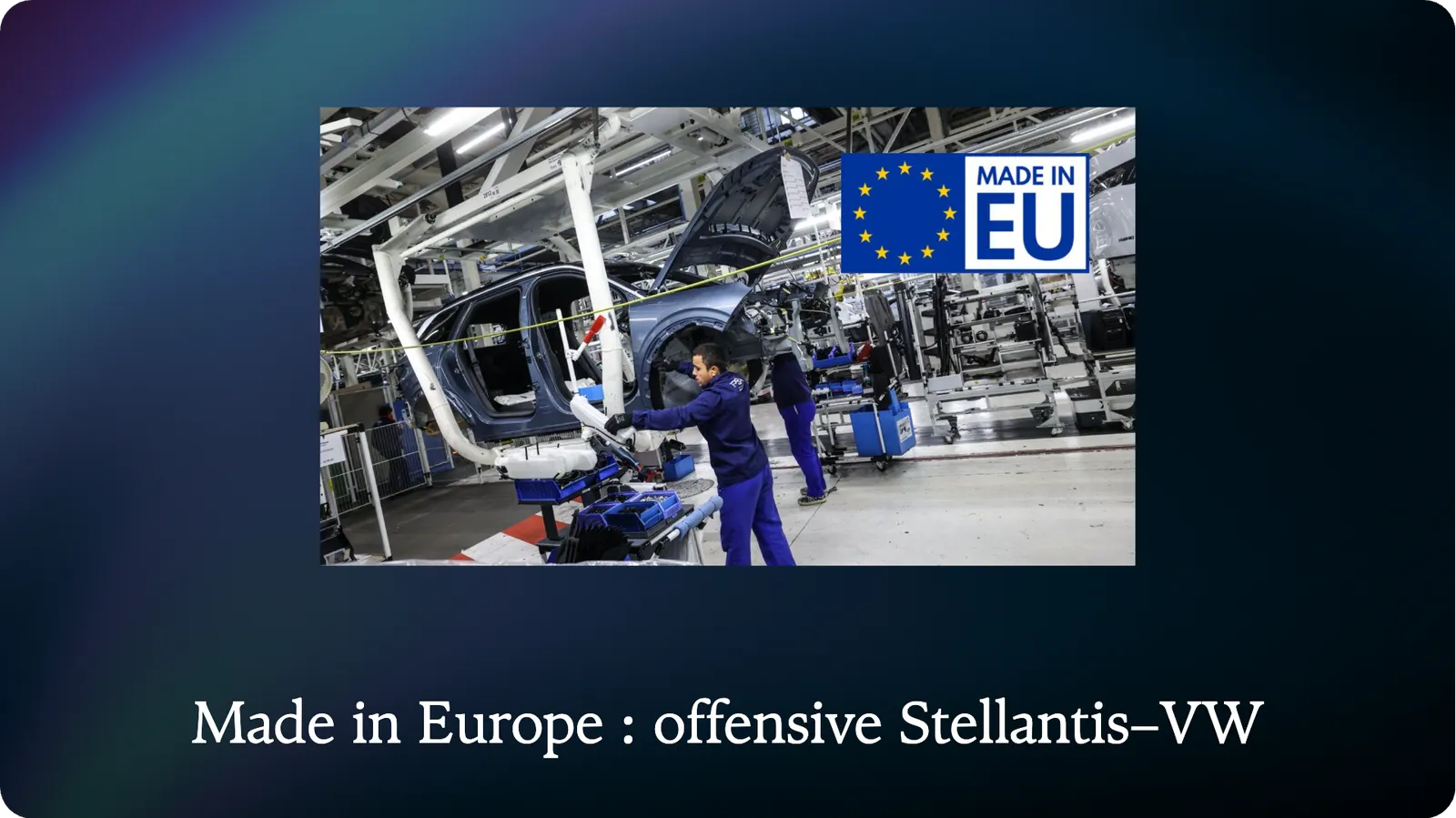
In a context of geopolitical rivalry where trade, technology and industry are becoming levers of power, Stellantis and Volkswagen are pushing a "Made in Europe" strategy to support the European automotive industry. In early February 2026, Oliver Blume (Volkswagen) and Antonio Filosa (Stellantis) co-signed an op-ed published by Handelsblatt and two other European dailies, as reported by ORF and blue News. The continent's two largest carmakers call on Brussels to link public subsidies and CO2 regulation to the European origin of electric vehicles.
A strategic sector under pressure
The stakes are first and foremost economic. According to the European automobile manufacturers' association ACEA, the automotive industry generates more than 8% of the EU's GDP, employs 13.5 million Europeans and accounts for 8% of manufacturing jobs in the EU. It also carries significant weight in innovation: ACEA puts its R&D spending at €84.3 billion a year, or 34% of the European total.
The two executives' assessment: most cars sold in the Union are still assembled there, but European manufacturers face competition from importers subject to less stringent social and environmental standards, while tensions over critical materials are weakening value chains. The EU's CO2 targets add a further constraint: a manufacturer that does not sell enough electric vehicles faces penalties, which encourages it to import the cheapest components available.
The battery dilemma
The dilemma crystallizes around batteries. Europe is investing to build an integrated cell industry, but the race for affordable electric vehicles increases the pressure to import cheaper cells, mainly from Asia. This deprives European plants of the volumes they need to break even, which in turn deepens dependence on imports: a vicious circle that threatens the continent's technological sovereignty.
What Stellantis and Volkswagen are proposing
Their proposal rests on two pillars. First, requiring equivalent production conditions for any company that wants to sell in Europe. Second, targeting public money at local value added through a "Made in Europe" label. According to Mac4Ever, its criteria, still to be defined, would cover:
- vehicle production and research and development;
- the electric powertrain;
- battery cells;
- key electronic components.
Only labeled models would have access to purchase incentives, fleet programs and public procurement. The two CEOs also put forward a "CO2 bonus" for each "Made in Europe" electric vehicle, extended to a manufacturer's entire electric lineup if a large share of its fleet meets the criteria, according to ORF. The stated goal: to reduce regulatory penalties and reinvest the savings in R&D. The signatories reject any charge of protectionism, but the proposal opens a sensitive debate with the EU's trading partners, at the intersection of climate policy, industrial policy and free competition.
What is at stake for businesses
If Brussels adopts this logic, the origin of components will become a commercial criterion as much as a regulatory one. Suppliers will have to document the provenance of their cells and electronics to remain eligible for their customers' programs. Importers, European and Asian alike, will be encouraged to localize part of their production. Public buyers and fleet managers will have to build the label into their tenders. For tier 2 or tier 3 suppliers, value chain traceability could become a condition of market access.
What monitoring teams should watch
- The Commission's text on European preference in industry and the revision of CO2 rules: this is where local content thresholds will be set. Regulatory monitoring of consultations and amendments gives several months' head start.
- The positions of other carmakers and member states, not all of which see the value of the label, depending on their exposure to exports.
- Announcements of cell plants in Europe, their delays and their partnerships with Asian players, to be tracked through automotive industry monitoring.
- Reactions from trading partners (China, the United States, Korea) and the risk of retaliatory measures, which fall under geopolitical monitoring.
- Traceability requirements imposed on suppliers, which will reshape procurement risk mapping.
Sources
- ORF, VW und Stellantis fordern Bevorzugung europäischer E-Autos (2026)
- blue News, VW and Stellantis: "Made in Europe" to strengthen the industry (2026)
- Mac4Ever, Stellantis et Volkswagen demandent un bonus CO2 pour les voitures électriques Made in Europe (2026)
- ACEA, key figures of the European automotive industry (2025)
Go deeper
All reportsThree NewsCore reports that build on this article.
- ID : NSC/AUTO/0002
CATL, BYD, LG Energy, Samsung SDI, Panasonic; solid-state timelines Toyota, ProLogium, Solid Power.
€7,500Request - ID : NSC/BTP/0007
ICON Wolf Ranch, COBOD BOD2, XtreeE, Saint-Gobain Weber Beamix: projects and economics.
€6,500Request - ID : NSC/BFSI/0020
DORA enforcement January 2025, ICT registers, TLPT tests, cloud provider governance.
€6,500Request