

The Invisible Battle of Intelligence
Facing hybrid threats, intelligence has become a pillar of national security. The DGSE, the DRM and the DRSD, the three services of the French Ministry of the Armed Forces, combine artificial intelligence tools and human expertise to preserve France's ability to anticipate and its sovereignty.
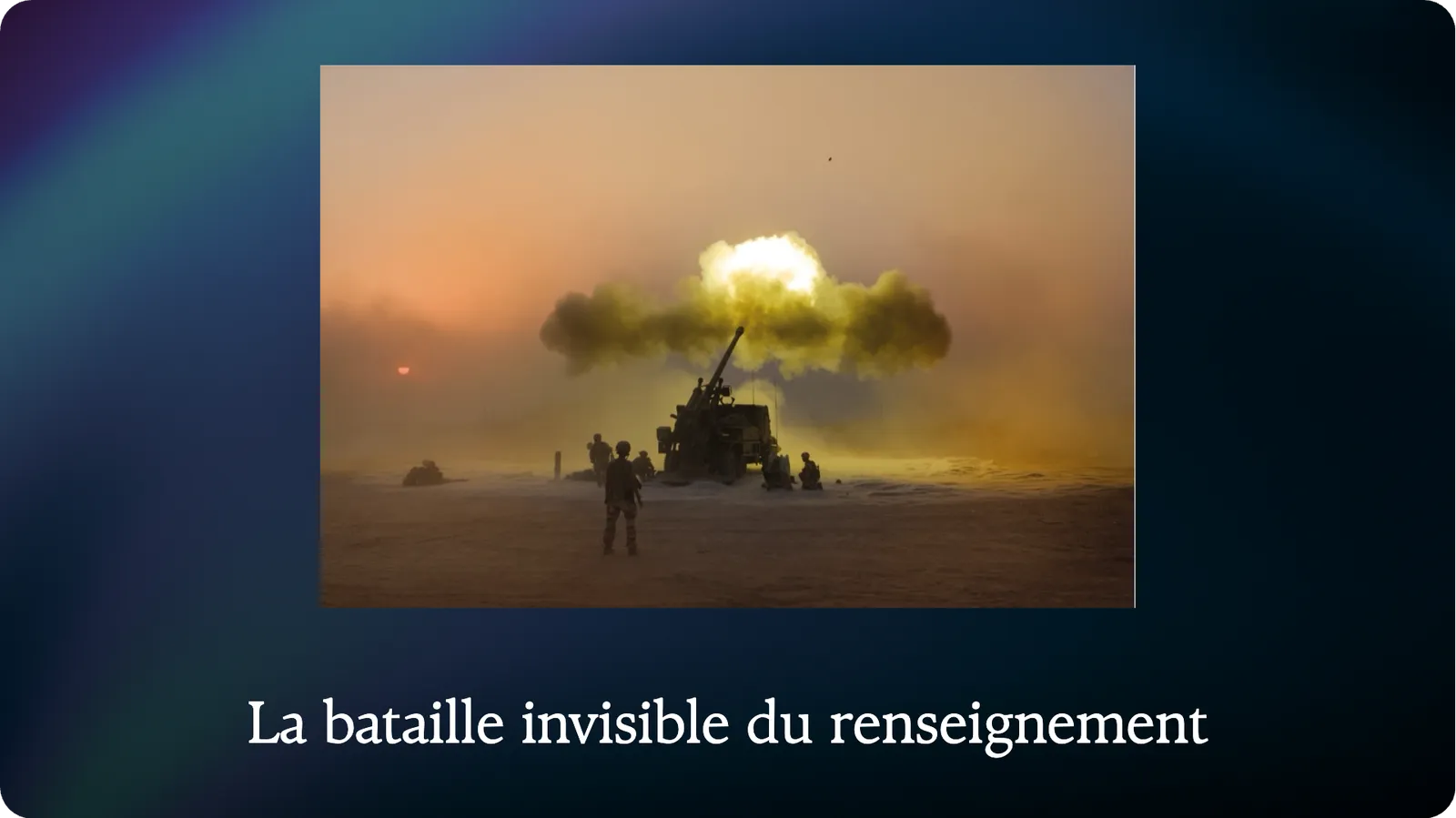
War in Ukraine, tensions in the Middle East, a loosening transatlantic bond, rivalries in Africa over influence and natural resources: in a world shaped by a lasting systemic crisis, warfare is taking new forms. Cyberattacks, interference, hybrid conflicts, asymmetric warfare and cognitive warfare blur the line between peacetime and crisis. In this context, intelligence is no longer just an asset: it is becoming a pillar of national security.
Three services, three distinct roles
Within the French intelligence community, three services report to the Ministry of the Armed Forces.
The DGSE, in charge of foreign intelligence, brings together some 7,000 women and men, civilian and military. Its official website lists five missions: counterterrorism, counterproliferation, geopolitics, counterintelligence and cyberdefense.
The DRM, the Directorate of Military Intelligence, operates under the authority of the Chief of the Defence Staff. It assesses the military capabilities of current or potential adversaries, supports forces in operations and informs the decisions of political and military authorities. According to the Ministry of the Armed Forces, it has nearly 2,100 staff and coordinates the joint intelligence function, which brings together around 8,000 specialists. It works across three horizons: anticipating crises over the long term, supporting decisions over the medium term and providing operational support in the short term.
The DRSD, the Directorate of Intelligence and Security for Defence, created in 2016, has defense counter-interference as its core business: detecting and thwarting threats against the armed forces and defense-related companies. As it scales up, it recruits hundreds of people every year, according to its institutional page.
Each of these services has its own role, but all converge on the same goal: giving France reliable knowledge, the ability to anticipate threats and the means to protect its forces, its technologies and its sovereignty.
A twofold challenge: volume and meaning
The first challenge is quantitative. Satellite imagery, electromagnetic signals, cyber flows, human intelligence: the volume of data to process exceeds what humans alone can handle. The second is interpretive: weak signals must be extracted from this mass, those early indications of a crisis, of hostile intent or of a threat that is not yet visible.
The information threat illustrates this twofold challenge. VIGINUM, the service for vigilance and protection against foreign digital interference attached to the SGDSN, documented 77 operations conducted by the Russian modus operandi Storm-1516 up to March 5, 2025, aimed in particular at discrediting European figures and organizations ahead of elections, according to its analysis published by the Ministry of the Armed Forces. Detecting these campaigns requires processing large volumes of open-source content, then qualifying it.
AI and human judgment, complementary
To meet these challenges, the services rely on advanced tools (big data, artificial intelligence) to sort, cross-check and prioritize information. But the tool does not replace the analyst: qualifying a signal, assessing its reliability and putting it into perspective remain acts of judgment. Their cooperation is intensifying, providing a sovereign capacity for analysis and decision that forms the first, invisible, line of defense against today's threats.
Control over the tools themselves has become a central issue: a service that depends on foreign technology to analyze its sensitive data gives up part of its sovereignty. This is one of the drivers of current policies to reduce digital dependencies.
What monitoring teams should watch
- Public reports from VIGINUM and the services on interference methods, which also inform exposed companies; they feed monitoring of cyber risks and OSINT signals.
- Alerts from the DRSD and the DGSI on economic interference targeting defense companies and their subcontractors.
- Changes in the services' budgets and capabilities (recruitment, AI programs, supplier choices), which signal the state's priorities.
- Regional crises likely to affect sites and supply chains, to be tracked with dedicated geopolitical monitoring and an economic intelligence approach.
Sources
Go deeper
All reportsThree NewsCore reports that build on this article.
- ID : NSC/DEF/0013 · Window 1 month
NIST PQC, EU programmes, quantum sensors, QKD communications and threats to critical infrastructure.
€7,500Request - ID : NSC/LUXE/0002 · Window 12 months
Rolex, Patek Philippe, Richemont, Swatch Group: exports to China, India and the Middle East.
€7,000Request - ID : NSC/DEF/0001 · Window 6 months
Shahed-136, Lancet, Switchblade, Tekever AR3: battlefield lessons and accelerated European adoption.
€7,500Request