

Greenland: what stance for Europe?
US ambitions for Greenland opened an unprecedented crisis within NATO in January 2026. Europe backed Denmark and made Washington back down on tariffs, without settling the substance of the issue.
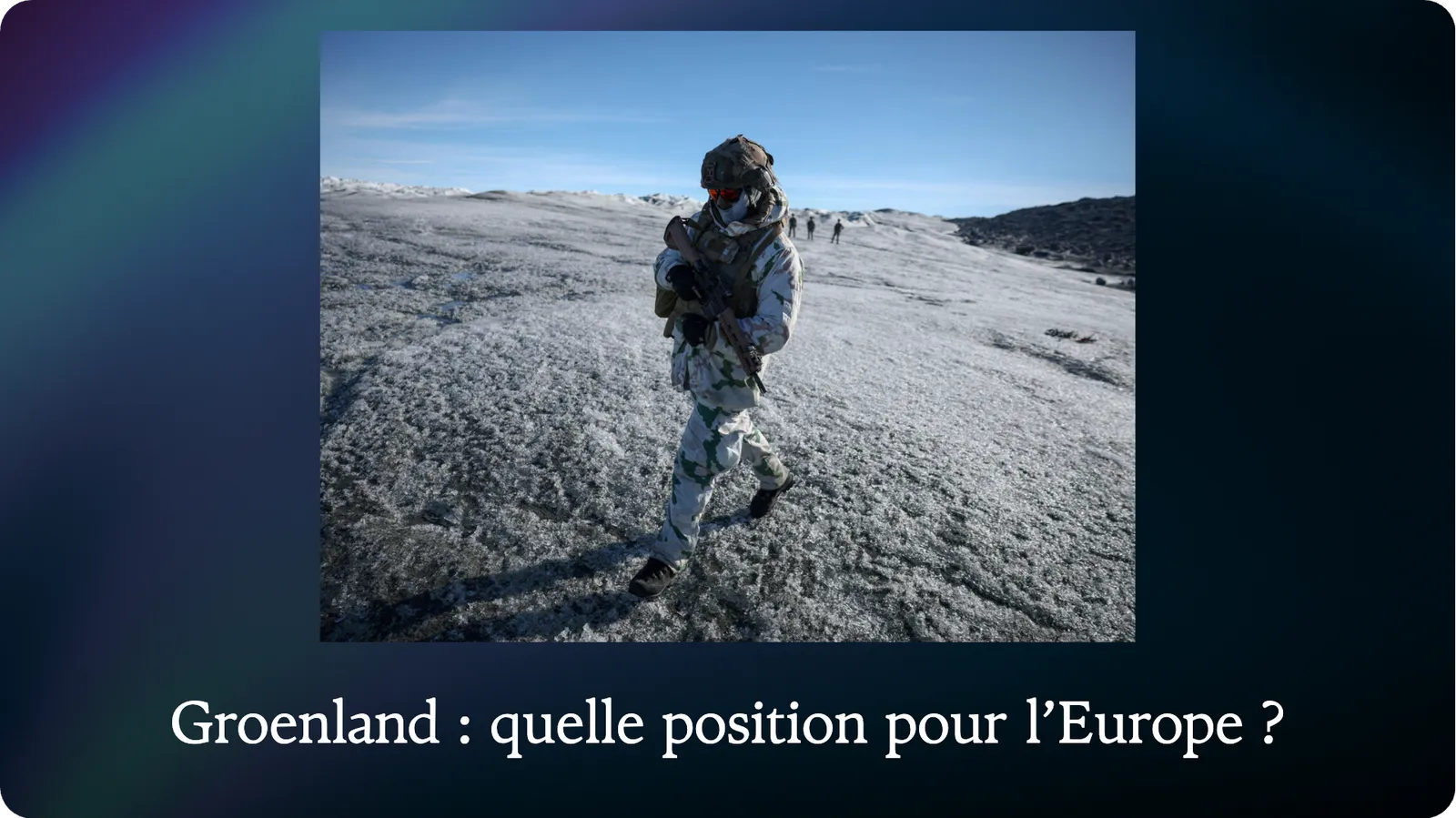
It will not have escaped your notice: since the start of 2026, Greenland has been the scene of unprecedented tensions between the United States and several European countries, to the point of calling into question the very functioning of NATO. Threats of annexation, a tariff ultimatum, symbolic military deployments and the opening of consulates: within a few weeks, the Arctic became a test of Europe’s ability to defend the sovereignty of one of its members against its main ally.
A coveted autonomous territory
The world’s largest island, very sparsely populated, is an autonomous territory within the Kingdom of Denmark. Its 2009 Self-Government Act, which extends the home rule arrangement introduced at the end of the 1970s, notably gives it authority over its natural resources and provides that revenue from the exploitation of its subsoil goes to Greenland, the International Energy Agency notes. Copenhagen retains foreign policy and defence.
Washington is interested in the island for several reasons: the sea routes that could open up in the Arctic, still untapped reserves of gas, oil and rare earths, and national security imperatives. Donald Trump considers Greenland critical to American security and has linked it to the “Golden Dome” missile defence project, according to Transport Topics.
January 2026: the escalation
In mid-January, as the Danish and Greenlandic foreign ministers failed to shift the American position at a meeting in Washington, European military personnel arrived in Nuuk: around fifteen French soldiers from a mountain infantry unit, a 13-strong German reconnaissance team, and small Swedish and Norwegian contingents, Al Jazeera reports. These deployments were part of the “Arctic Endurance” exercise, coordinated by Denmark with its allies.
On 17 January, Donald Trump threatened to impose, from 1 February, a 10% surcharge on imports from eight European countries, rising to 25% on 1 June in the absence of an agreement on the purchase of Greenland. The next day, Denmark, Finland, France, Germany, the Netherlands, Norway, Sweden and the United Kingdom responded with a joint statement: these tariffs undermine transatlantic relations and risk a “dangerous downward spiral”, and the signatories affirmed their full solidarity with Denmark and the people of Greenland, according to NPR.
An American climbdown, not a settlement
On 21 January, on the sidelines of the Davos Forum and after a meeting with NATO Secretary General Mark Rutte, Donald Trump dropped the tariffs planned for 1 February, citing the “framework of a future deal” concerning Greenland and the entire Arctic region, the terms of which were not specified, Transport Topics reports. He ruled out the use of force, while warning Europeans that their refusal would not be forgotten.
France then opened a consulate general in Nuuk on 6 February 2026, becoming the first European Union country to have a diplomatic representation in Greenland, according to The Daily Gazette. Negotiations between Denmark, Greenland and the United States are continuing.
What stance for Europe?
The episode showed that a coordinated response can make Washington back down in the short term. But it also revealed Europe’s fragility: security dependence on the United States within NATO, a weak military presence of its own in the Arctic, and commercial exposure to tariff retaliation. Facing its destiny, Europe will have to find lasting ways not to give in: a stronger diplomatic and military presence, investment in Greenland’s resources and infrastructure, and a common doctrine on the Arctic.
What monitoring teams should watch
For companies exposed to transatlantic trade, critical raw materials or shipping, this issue calls for continuous geopolitical monitoring. Signals to follow:
- The actual content of the US-Danish “framework”: military bases, mining rights, US involvement in subsoil resources.
- Any revival of US tariff threats against the European signatory countries.
- Greenlandic decisions on mining permits, particularly for rare earths, and the origin of the investors.
- European military deployments and exercises in the Arctic, indicators of the states’ real commitment.
- The effects on your critical materials supply chains, to be built into supplier risk monitoring.
Sources
- International Energy Agency, Greenland Self-Government Act (2009)
- Al Jazeera, European troops arrive in Greenland as talks with US hit wall over future (2026)
- NPR, European leaders warn Trump's Greenland tariffs threaten “dangerous downward spiral” (2026)
- Transport Topics, Trump drops Greenland tariff threat, cites “framework” deal (2026)
- The Daily Gazette, France becomes first EU country to open a consulate in Greenland (2026)
Go deeper
All reportsThree NewsCore reports that build on this article.
- ID : NSC/DEF/0003 · Window 3 months
Lasers, active radars, jamming, low-cost interceptors: Skyranger, Coyote, ELI/MS, MARSS.
€6,500Request - ID : NSC/AERO/0001
Strategic analysis of the Airbus-Thales-Leonardo merger (BROMO, 2027) and its impact on European space sovereignty against SpaceX and China.
€13,000Request - ID : NSC/BTP/0007
ICON Wolf Ranch, COBOD BOD2, XtreeE, Saint-Gobain Weber Beamix: projects and economics.
€6,500Request