

Arms: Mapping Global Dynamics
Between dependency, autonomy, and power projection, arms flows shape the contours of state influence and sovereignty worldwide.
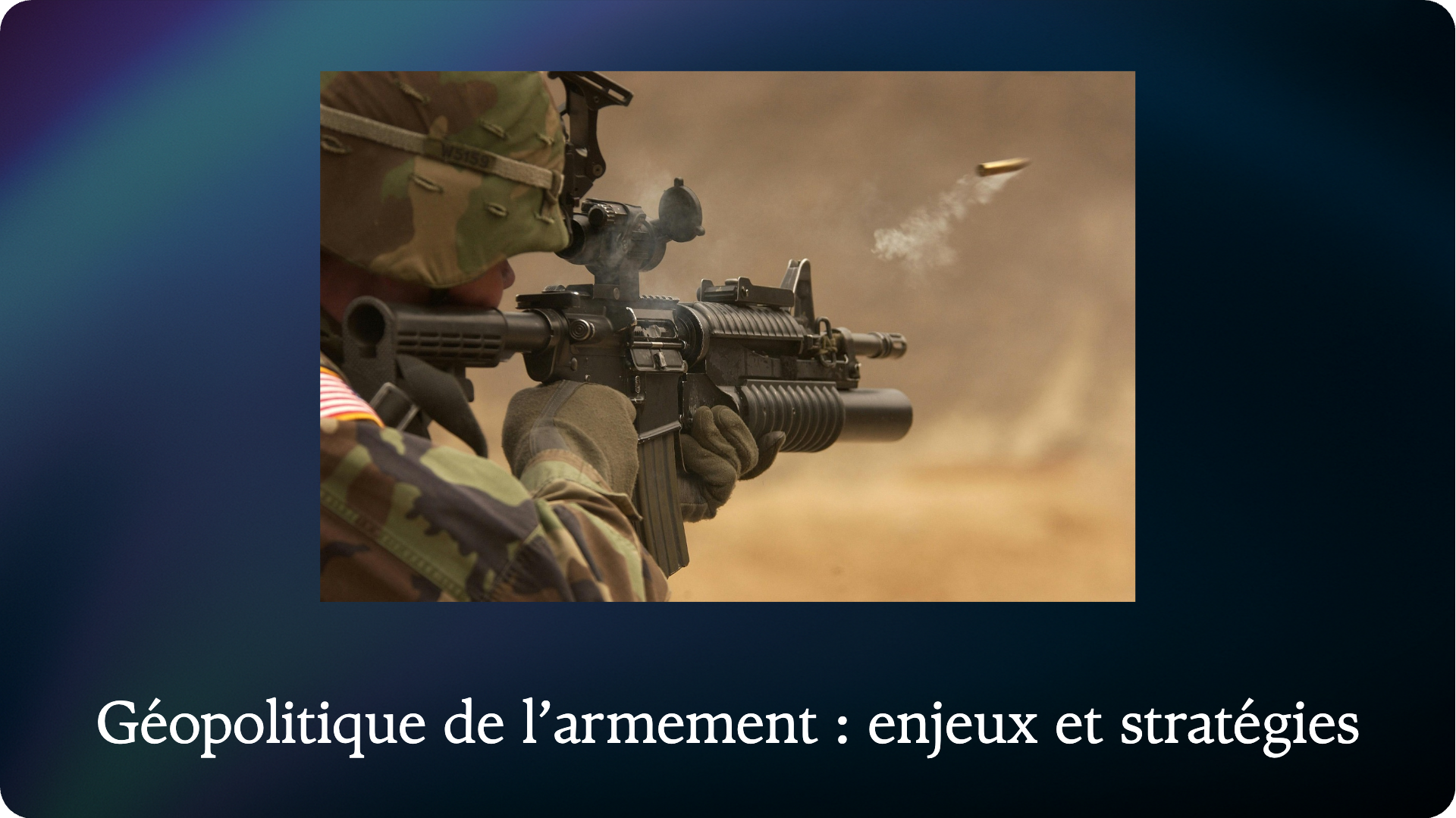
For a political unit, the acquisition of military capabilities contributes to the assertion of sovereignty and to its positioning within regional or global dynamics of competition. Armament is an instrument that makes it possible to impose one's will through the use or threat of force, and also to protect oneself from it. The circulation of weapons therefore cannot be considered neutral, since it contributes to the capability building of a political unit. In this framework, what do arms flows reveal about global geopolitics?
Do arms imports create dependency for states?
To carry weight on the international stage, two aspects of armament must be considered: its technological level and its capacity for deployment. The strategies adopted by states vary according to how they balance these two parameters. However, it can be difficult, especially for smaller political entities, to achieve a high level of performance across all capability domains. Importing makes it possible to access larger volumes as well as more advanced technologies than those available domestically. It is often easier to acquire a high-tech component than to develop an equivalent research and production capacity. Moreover, these imports remain closely linked to political relations between states. Rival states generally refrain from supplying each other with equipment that could strengthen the adversary's military capabilities. Arms transfers therefore fall within logics of political alignment. Although conditioned by political agreements, these exchanges also reflect power relations. The importing state may find itself in a situation of dependence on its partners, and any shift in political alignment is likely to affect the supply or maintenance of the acquired equipment. The American company Lockheed Martin is a good example of this dynamic. The firm ranks among the leading exporters of combat aircraft thanks to the F-35 Lightning II, sold to about twenty countries. This aircraft requires regular software updates, whose source code access is reserved for the United States and the manufacturer. Acquiring states therefore do not have full control over the system. If the partnership were called into question, access to updates could be restricted, jeopardizing the operation of the equipment. Importing countries benefit from cutting-edge technologies while remaining dependent on the political framework that governs their use.
Aware of the stakes linked to dependency, certain states seek to mitigate this imbalance. India ranks as the second-largest arms importer in the world, behind Ukraine between 2020 and 2024. The country reduces its dependence by diversifying its partners through a strategy of multi-alignment. This approach allows it both to avoid certain political pressures and to access the most advanced technologies offered by its various suppliers. It also strengthens its bargaining power by putting exporters in competition with each other and by including industrial offsets in contracts. For example, in 2005, India signed an agreement for the import of six French Scorpène submarines. Production relied on a joint supply chain involving both countries. The hybrid nature of the industrial setup contributed to national development and gave rise to significant technology transfers. Through this approach, India seeks to preserve its strategic autonomy while pursuing its acquisition programs.
Importing arms is not limited to a more or less pronounced dependency; it also contributes to the importing country's capability building. As mentioned earlier, it provides access to advanced technologies and to arms volumes superior to those produced locally. China made extensive use of arms imports, being the world's leading recipient between 2004 and 2008 with 11% of global imports. The imported equipment generated technology transfers, which China then reproduced for national production. For example, in 1993, China acquired the Russian S-300 air defense systems, and the Chinese HQ-9 subsequently showed many similarities. This strategy enabled the Chinese Defense Industrial and Technological Base (DITB) to develop and gradually gain autonomy. China has now significantly reduced its purchases of foreign weapons thanks to progressive national substitution. Between 2020 and 2024, it ranks 16th among importing countries, a level much lower than twenty years earlier. Since 2016, China has announced its intention to develop its exports and is now the fourth-largest exporter in the world. Imports have thus made it possible to progressively reduce the country's dependence through technology transfers and the strengthening of its national capabilities.
Exports: an instrument serving national defense interests.
Depending on the size of the domestic market, reflected in the defense budget, the DITB is more or less able to meet its needs autonomously. The more developed the national defense industry, the more the balance of programs and the proper functioning of companies are ensured. Conversely, when the resources devoted to defense are limited, the DITB cannot maintain its activity solely through national orders. Once state demand is met, the production line tends to erode gradually. Many components then disappear from the market, making any potential restart of production difficult. The maintenance of existing equipment also becomes more complex when components and know-how become scarce. Two solutions can be considered. On the one hand, slowing the pace of production in order to delay the depletion of industrial capacities. On the other hand, the state can turn to exports, generating new revenue sources for companies. Opening arms production to international markets therefore helps to maintain the performance of the national DITB. For middle powers, exports appear as a lever to support national production. However, like imports, exports remain subject to political stakes and depend on diplomatic relations between states. Every export is subject to prior review and is not considered when the state wishes to limit the diffusion of an advanced technology from which it derives an advantage on the international stage.
The will to export to support national defense interests is not enough; the equipment must also be attractive in the global arms competition. Manufacturers tend to specialize in order to increase their competitiveness on the international market. Technologies quickly become obsolete, replaced by competing systems seeking to attract buyers' attention. France decided to stop producing its assault rifle, the FAMAS. Its production was no longer competitive on the world market, facing intense competition and outdated technology compared with international standards. By ceasing this production, the DITB refocused on areas with higher added value where it holds a technological advantage, notably in combat aviation and naval equipment. This equipment is more expensive. For example, the Mirage 2000 fighter-bomber is estimated at between 20 and 40 million euros, while its successor, the Rafale, ranges between 70 and 90 million euros. Advanced and more expensive technologies are produced and distributed in smaller volumes. This orientation toward technological competition has consequences for the depth of available forces. It is particularly visible within European nations. The French Army is often described as a "bonsai army" to underline its comprehensiveness at the expense of its mass. The former head of Lockheed Martin gave his name to "Augustine's Law" to illustrate this phenomenon, describing an uncontrolled rise in the cost of armaments while defense budgets grow at a more modest pace. Although it does not rest on a strict scientific foundation, this approach offers a useful lens for analyzing the evolution of armed forces on a global scale.
Armament: a reflection of power hierarchies and strategies.
The United States holds a dominant position in arms exports, accounting for 43% of the global market share. Its advanced industry and technological superiority give it the role of an unavoidable player in military flows. This leading position provides leverage, exercised notably through ITAR (International Traffic in Arms Regulations). Under this regulation, any American component, software, or data cannot be incorporated into the commercialization of a product manufactured outside the United States without their authorization.
In other words, the U.S. State Department has oversight over the approval of any export containing an ITAR-controlled element. The United States has also established a list of countries banned from accessing ITAR technologies, such as Iran or China. Consequently, any non-American export to these countries that incorporates an ITAR component is automatically blocked. In the event of a violation, U.S. authorities can impose heavy financial sanctions, as has happened with ITT Corporation, Airbus, or BAE Systems. This extraterritorial regulation constitutes a diplomatic instrument serving American power. To respond, some companies have developed so-called "ITAR-FREE" solutions, limiting or excluding the use of components subject to U.S. controls. These products are presented as a way to preserve buyers' sovereignty in the management of their military equipment. Europe, Russia, and China have pursued this goal by developing independent equipment. However, these initiatives remain marginal in a market largely dominated by the United States.
The choice of client and supplier is, as mentioned, closely linked to politics. As such, the transfer of military equipment reflects the global geopolitical configuration. In 2017, Turkey signed a contract estimated at 2.5 billion dollars for the acquisition of the S-400 air defense system from Russia. Although a NATO member, Turkey did not turn to its American or European partners for the acquisition of this system, marking a repositioning of its alliances. In response, the United States sanctioned Turkey through CAATSA (Countering America's Adversaries Through Sanctions Act), a U.S. law aimed at penalizing countries that cooperate militarily with Russia, Iran, or North Korea. Consequently, in 2020, the United States suspended all military licenses and exports to Turkey, including the supply of F-35s. These situations underscore that arms exchanges are embedded in power dynamics on the international stage.
A state's positioning as an arms importer or exporter is first conditioned by its national ambitions. Following the annexation of Crimea, and then reinforced during the invasion of Ukraine by Russia, the United States imposed financial and commercial sanctions on the Russian DITB, placing the country on the list of states prohibited from military cooperation under CAATSA. Some clients of the Russian DITB, subject to these sanctions, broke off their contracts, depriving Russia of certain commercial partners. In addition, the country saw its access to components essential to its capability building hindered. These decisions, combined with the context of war in Ukraine, led to a restructuring of the Russian arms industry. Exports fell sharply in order to focus production on the needs of Russian forces engaged in Ukraine. Between 2015 and 2024, the volume of Russian exports dropped by 64%. Russia's political orientations on the international stage have thus led to a reorganization of exports in order to meet the needs of its national sovereignty.
The circulation of defense capabilities helps shape power relations on the international stage. While state strategies differ in their action plans, they converge on the goal of strengthening national power. Arms movements reflect geopolitical dynamics.
Sources:
Bromley, M., Holtom, P., Wezeman, P. D., & Wezeman, S. T. (n.d.). SIPRI Arms Transfers Data, 2008. SIPRI. https://www.sipri.org/publications/2009/sipri-fact-sheets/sipriarms-transfers-data-2008
George, M., Djokic, K., Hussain, Z., Wezeman, P. D., & Wezeman, S. T. (2025b). Trends in International Arms Transfers, 2024. https://doi.org/10.55163/xxsz9056
Les industries de défense. (2025). Annales des Mines - Réalités industrielles, (August), https://stm.cairn.info/revue-annales-des-mines-realites-industrielles-2025-3?lang=fr
Nabet, P., & Rademacher, B. (2025). Les dynamiques mondiales du secteur industriel de la défense. Annales des Mines - Réalités Industrielles, August(3), 43-46. https://doi.org/10.3917/rindu1.253.0043
Péria-Peigné, L. (2024). Géopolitique de l'armement : Instrument et reflet des relations internationales. Le Cavalier Bleu. https://shs.cairn.info/geopolitique-de-l-armement--9791031806938?lang=fr
Go deeper
All reportsThree NewsCore reports that build on this article.
- ID : NSC/DEF/0013 · Window 1 month
NIST PQC, EU programmes, quantum sensors, QKD communications and threats to critical infrastructure.
€7,500Request - ID : NSC/DEF/0001 · Window 6 months
Shahed-136, Lancet, Switchblade, Tekever AR3: battlefield lessons and accelerated European adoption.
€7,500Request - ID : NSC/DEF/0018 · Window 12 months
European Sky Shield, Aster 30 B1NT, IRIS-T SLM, Patriot PAC-3 MSE: accelerated European adoption.
€7,000Request