

Essequibo: Guyana refuses to negotiate with Caracas
Guyana rules out any bilateral negotiation over Essequibo and relies on the International Court of Justice, as Caracas changes leaders. France, which has opened an embassy in Georgetown, is strengthening its presence: a sign of the priority given to regional stability.
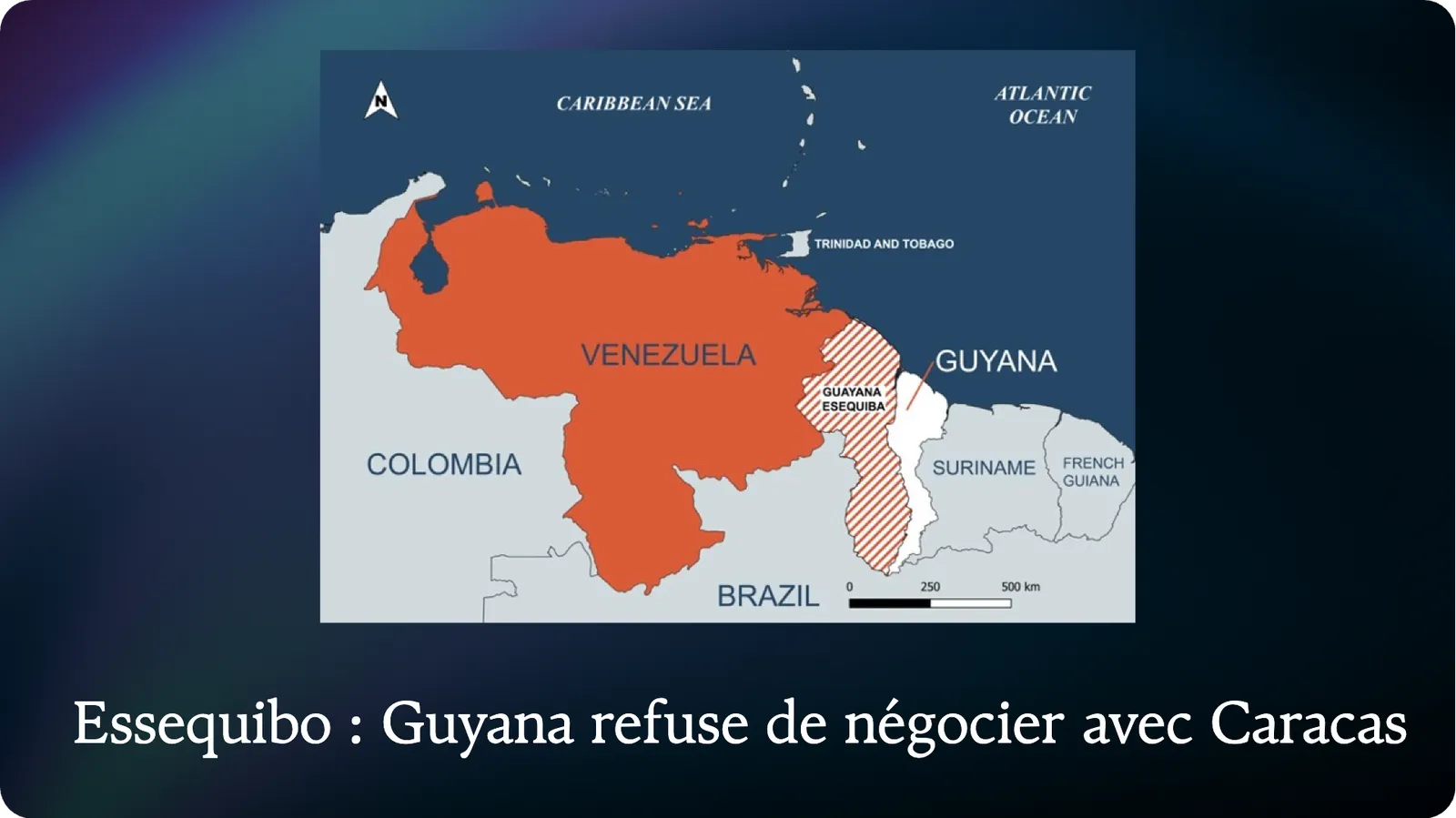
Guyana’s President, Irfaan Ali, reportedly reaffirmed in mid-January that he would not enter into any direct negotiations with Venezuela over the disputed Essequibo region, as the dispute must be settled by the International Court of Justice (ICJ). The line is not new: as early as December 2023, he said he was ready to discuss anything with Caracas except the border, the Jamaica Observer reported. But it takes on particular significance now that power has changed hands in Caracas.
A century-old dispute before the ICJ
Essequibo, which covers a large part of Guyanese territory, has long been claimed by Venezuela, which contests the 1899 arbitral award that set the border. Guyana brought the case before the ICJ in March 2018. The Court declared itself competent in December 2020, rejected Venezuela’s preliminary objection in April 2023, then ordered provisional measures in December 2023 and May 2025, according to the official case page. Hearings on the merits are scheduled for May 2026. Caracas, for its part, does not recognise the Court’s jurisdiction.
An oil stake that has become strategic
The hydrocarbon-rich area became a strategic issue after major offshore oil discoveries. Guyana produced 261.1 million barrels of crude in 2025, according to figures from the Finance Minister reported by OilNOW, output that emerged in just a few years. Any escalation over Essequibo would therefore directly expose offshore operators and their subcontractors.
Caracas under new leadership
The Venezuelan context shifted in early January. After the capture of Nicolás Maduro by US forces on 3 January, the military recognised Vice President Delcy Rodríguez as interim leader, CBS News reports. There is no indication at this stage that this change alters Venezuela’s claim to Essequibo, which the Venezuelan state has pursued for decades. By refusing the bilateral route, Georgetown aims to prevent the transition in Caracas from reopening territorial bargaining.
A legal framework that weighs on investors
Keeping to an exclusively legal framework creates a level of uncertainty for investors and energy operators, who must factor this volatility into their decisions: launching, adjusting or suspending projects depending on country risk. The absence of a bilateral agreement reinforces legal constraints and encourages caution among the players concerned, especially since in practice the ICJ ruling will only take effect if Caracas agrees to apply it.
France strengthens its presence
At the same time, France has consolidated its presence on the Guiana Shield. In September 2025 it opened an embassy in Georgetown, also accredited to CARICOM, replacing the diplomatic office set up in 2023, according to the Ministry for Europe and Foreign Affairs. Present on the Guiana Shield through French Guiana, France is thus signalling its intention to strengthen bilateral cooperation on regional stability, security and infrastructure.
What is at stake for companies
This is a key signal for operators exposed to the extractive sector and oil services, in an environment where legal certainty remains decisive for strategic planning. Subcontractors, shipowners and insurers operating off Guyana must build a tension scenario, however unlikely, into their continuity plans.
What monitoring teams should watch
- The ICJ timetable (hearings in May 2026, then the date of the ruling) and Caracas’s reaction at each stage.
- Statements by Delcy Rodríguez and the Venezuelan military on Essequibo, and any military movement near the border, to be tracked through geopolitical country risk monitoring.
- Changes to US and European sanctions targeting Venezuela after Maduro’s fall, through international sanctions monitoring.
- Investment decisions by offshore operators and subcontractors’ exposure, to be documented when tracking supplier and third-party risks.
Sources
- International Court of Justice, Arbitral Award of 3 October 1899 (Guyana v. Venezuela) (2026)
- Jamaica Observer, Guyana leader says he'll discuss anything with Maduro, except border (2023)
- CBS News, Venezuela's military recognizes Delcy Rodriguez as acting leader after Maduro's capture (2026)
- OilNOW, Guyana produced 261.1 million barrels of crude in 2025 (2026)
- France Diplomatie, Guyana : ouverture de l'ambassade de France (2025)
Go deeper
All reportsThree NewsCore reports that build on this article.
- ID : NSC/ENER/0017 · Window 12 months
Net-zero target retreats, upstream capex, integrated power and low-carbon strategies.
€7,000Request - ID : NSC/ENER/0016
QatarEnergy, Cheniere, Venture Global, North Field expansion; Russian gas substitution.
€7,000Request - ID : NSC/ENER/0003
Natrium Wyoming Kemmerer, Xe-100 Dow Chemical, hyperscaler PPAs and Big Tech 10+ GW commitments.
€7,000Request