

Economic Intelligence and Sports Diplomacy
Economic intelligence is key to French sports diplomacy and influence, yet remains underused despite the country's strong assets.
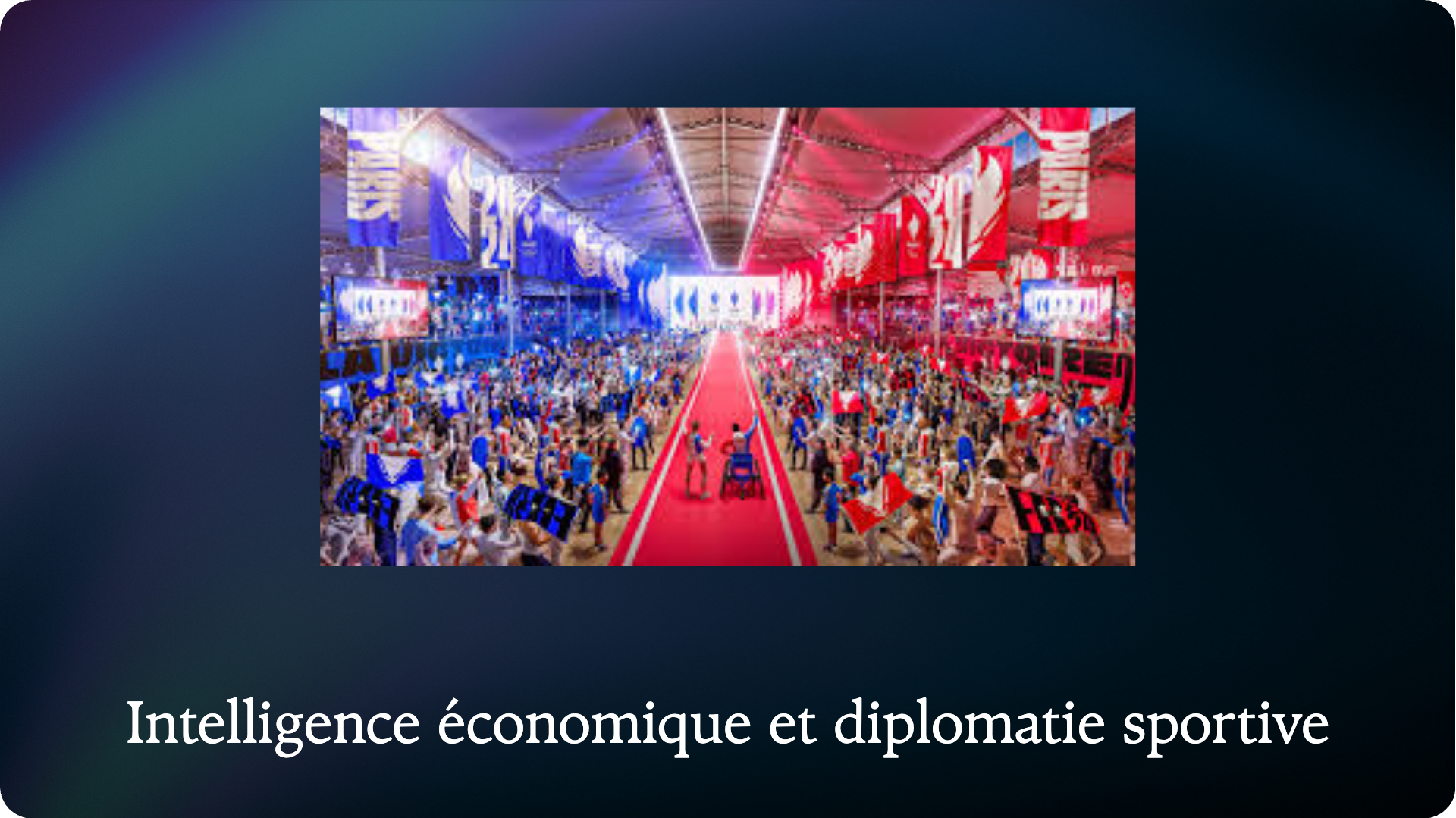
In an international context marked by the intensification of power rivalries and by a diversification of instruments of influence, sport is gradually emerging as a strategic lever of diplomacy and international visibility for states. Long perceived as a mere vehicle for social cohesion or entertainment, sport is now recognized as a tool of soft power, capable of shaping a country's international image, strengthening its attractiveness, and opening channels for political, economic, and cultural cooperation. France, with its long sporting tradition and recognized expertise in organizing international events, is fully part of this dynamic, as illustrated by its hosting of the 2023 Rugby World Cup and the 2024 Paris Olympic and Paralympic Games.
However, while French sports diplomacy enjoys undeniable strengths, it remains confronted with an extremely competitive environment, in which certain states deploy coordinated strategies of influence, anticipation, and information gathering. In this context, economic intelligence appears as a central tool, yet one that is still insufficiently integrated into the French sporting universe. A cross-cutting concept at the intersection of strategic monitoring, information protection, and influence, economic intelligence enables public and private actors to better understand their environment, anticipate developments, and defend their interests in a globalized system.
It is therefore worth examining the place and role of economic intelligence in sport, and more specifically its contribution to the international visibility of French sports diplomacy. How can we explain the invisibility of economic intelligence in the sports sector? In what way can it serve as an instrument for the diffusion and expansion of the French sports model? Finally, how can economic intelligence strengthen France's influence in Europe and on the international stage through sport?
To address these central questions, this article will successively analyze economic intelligence as a blind spot in the French sporting universe and in French sports diplomacy (I), then as an instrument supporting the expansion of the French sports model (II), before considering its role as a tool for increasing France's sporting influence and diplomacy in Europe and on the international stage (III).
I. Economic intelligence: a blind spot in France's sporting universe and sports diplomacy.
Despite the rise of sport as a strategic field in international relations, economic intelligence remains marginal in French sports governance. This situation can be partly explained by a historically siloed approach to sport, long confined to sectoral public policies (youth, health, social cohesion) and rarely considered through the lens of economic and geopolitical competition.
In the sporting world, the notion of economic intelligence is often reduced to informal practices of competitive monitoring or sports scouting, without genuine strategic structuring. Yet contemporary sport constitutes a complex ecosystem, involving international federations, professional leagues, sponsors, broadcasters, marketing agencies, and states, in which information has become a key resource. The awarding of major sporting events, the negotiation of broadcasting rights, the regulation of athlete flows, and the normative influence exercised within international bodies all reflect genuine informational power dynamics.
France, although it has national institutions dedicated to economic intelligence, struggles to fully connect them with the sports field. Monitoring, know-how protection, and influence strategies are still insufficiently integrated into sports and diplomatic policies. This gap contrasts with the approach of certain states that have turned sport into an openly recognized pillar of their international influence strategy, such as the United States, China, or Qatar.
Furthermore, French sports diplomacy suffers from a lack of coordination between public and private actors. Ministries, sports federations, local authorities, and companies often intervene in a fragmented manner, without a shared strategic vision based on systematic use of information. As economic intelligence literature underscores, the absence of a shared culture of monitoring and anticipation constitutes a factor of vulnerability in a globalized competitive environment.
Thus, economic intelligence still appears as a blind spot in French sport, even though it could constitute an essential lever of performance, protection, and influence in service of sports diplomacy.
II. Economic intelligence as an instrument for the expansion of the French sports model.
However, although the preceding assessment remains relevant and supported by factual observations, it appears that economic intelligence offers concrete prospects for supporting the international expansion of the French sports model. This model rests on a singular balance between public intervention, federal structuring, and progressive professionalization, which constitutes a distinctive asset in the global sports landscape.
Economic intelligence first makes it possible to strengthen the strategic monitoring capabilities of French sports actors. The analysis of foreign sports policies, investment strategies in sport, and international regulatory developments is an indispensable prerequisite for any effort to export expertise. Whether in event engineering, executive training, or infrastructure management, France has internationally recognized know-how that is still insufficiently leveraged in a coordinated manner.
Next, economic intelligence contributes to the protection of the intangible assets of French sport. Training methodologies, technological innovations, governance models, and event security expertise represent strategic resources that may be copied or misappropriated. A structured approach to information protection would secure these assets while enabling their controlled international diffusion.
Economic intelligence is also a tool of normative influence. By actively participating in the development of international standards (whether in sports governance, anti-doping efforts, or the social responsibility of sports organizations), France can promote its values and practices. This capacity for influence relies on a fine understanding of decision-making networks and stakeholder dynamics, a domain in which economic intelligence plays a central role.
Finally, as the reference video on economic intelligence and sport highlights, the challenge lies in the ability to move from a reactive to a proactive logic, by anticipating shifts in global sport and positioning France as a leading actor in the global sports field and its related emerging domains.
III. Economic intelligence: a tool to expand France's sporting influence and diplomacy in Europe and on the international stage.
On the diplomatic front, economic intelligence applied to sport enables France to strengthen its influence both at the European and international levels. Within the European space, sport constitutes a field of cooperation but also of competition between national models. The ability to anticipate the European Commission's orientations, weigh in on common sports policies, and defend the specific features of the French model requires in-depth mastery of strategic information.
At the international level, sports diplomacy is increasingly embedded in global influence strategies. Hosting major events, maintaining a presence in international sports bodies, and developing bilateral sports partnerships are all vectors of visibility. Economic intelligence makes it possible to identify priority zones of influence, map key actors, and design action strategies tailored to local contexts.
France can thus mobilize sport as a tool of cooperation and dialogue, particularly with French-speaking countries, emerging states, or strategic partners, in line with the sports diplomacy strategy it is developing. In this context, economic intelligence helps align sporting objectives with the country's diplomatic, economic, and cultural priorities. It also encourages a better articulation between state diplomacy and the diplomacy of non-state actors, such as federations, clubs, and companies in the sports sector.
In a context of growing competition between sporting powers, integrating economic intelligence into French sports diplomacy appears to be an essential condition of credibility and effectiveness. It makes it possible to move beyond an event-driven approach to sport and turn it into a genuine instrument of soft power, embedded in a global and long-term strategy.
The analysis of economic intelligence in the field of sport highlights its still largely untapped potential in service of France's sports diplomacy. Long considered peripheral, economic intelligence nevertheless appears as an essential strategic lever in a globalized, competitive, and highly politicized sporting environment. By identifying the structural weaknesses in the integration of economic intelligence into the French sporting universe, this article has shown the need for a paradigm shift. Economic intelligence can not only support the expansion of the French sports model but also strengthen France's influence in Europe and on the international stage by combining monitoring, protection, and influence. At a time when sport asserts itself as a central instrument of soft power, the challenge for France lies in its ability to structure a genuine economic intelligence strategy applied to sport, bringing together public and private actors. Such an approach would make it possible to turn sporting and organizational successes into lasting gains in credibility, attractiveness, and diplomatic influence, thereby consolidating France's place as a leading sporting and diplomatic power.
Sources:
Nye, J. (2004). Soft Power: The Means to Success in World Politics. PublicAffairs.
Skema Business School (2024, September 26). Intelligence économique : un outil qui nous permet de mieux comprendre l’économie du sport ? [Video]. YouTube. URL: https://youtu.be/ni5YB9KhaJw?si=wDTJVDguDZxo0lzp
European Commission (2011, January 18). Developing the European Dimension in Sport. European Union. EUR-Lex - 52011DC0012 - EN - EUR-Lex
France Diplomatie (2026, January). What is sports diplomacy? Ministry for Europe and Foreign Affairs. What is sports diplomacy? Ministry for Europe and Foreign Affairs
Go deeper
All reportsThree NewsCore reports that build on this article.
- Content Creators and Athlete MediaBest sellerID : NSC/SPRT/0010 · Window 12 months
KSI, Jake Paul, Travis Kelce, Patrick Mahomes: athlete-media and new ad models.
€5,500Request - ID : NSC/SPRT/0002 · Window 12 months
2027 Women's World Cup, Euro 2025, kit sponsorship, player bonuses and prize-money equality.
€6,500Request - ID : NSC/PHRM/0005
Resmetirom (Rezdiffra), tirzepatide in NASH, retatrutide, Madrigal, Akero: new GLP-1 indications.
€7,000Request