

Defense: 2026, the make-or-break year
Produce more, faster and cheaper: in 2026, the French defense industry must move from a small-series model to a volume model.
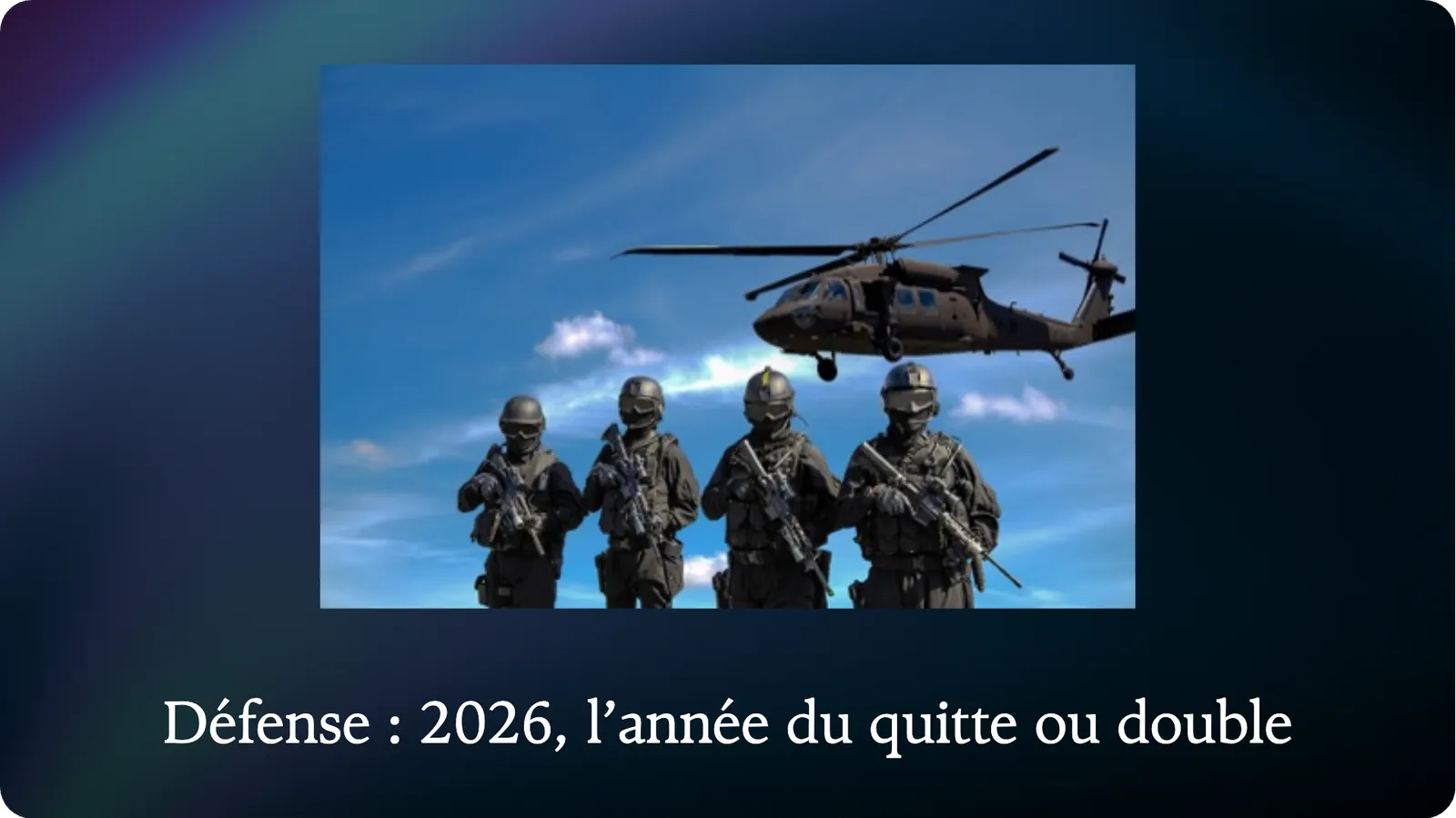
"Produce more, lighter, faster, stronger, cheaper": according to Consultor, this is the watchword addressed at the start of 2026 to French defense players, for whom the year looks decisive. The consultants interviewed by the publication describe an industry under pressure to change its model in the face of a deteriorating geopolitical context: fewer small series delivered over decades, more volume, shorter lead times and a more robust national supply chain.
Vincent Desportes, partner at the consulting firm Avencore, sums up the shift as moving "from a flow economy to a stock economy". The challenge, according to the experts quoted, is to go from a few dozen pieces of equipment a year to several hundred, while development cycles for new products still last five to seven years.
The context: demand on a new scale
France approaches this turning point from a position of strength on export markets. According to SIPRI, it was the world's second-largest arms exporter over the 2021-2025 period, with 9.8% of global exports, sales up 21% compared with 2016-2020. Over the same time, arms imports by European countries more than tripled (+210%) between the two periods: the continent's demand is changing scale.
On the national budget side, the effort is accelerating. The bill updating the military programming law, examined in the National Assembly from 4 May 2026, provides for an additional 36 billion euros over 2026-2030, including 3.5 billion as early as 2026, reports LCP. In particular, it earmarks 8.5 billion euros for rebuilding ammunition stocks and 1.6 billion for drones and counter-drone capabilities. The Minister of the Armed Forces, Catherine Vautrin, says France will exceed 2.5% of GDP devoted to defense in 2030.
The players: large groups, mid-sized companies and new entrants
The defense industrial and technological base (BITD) comprises around 4,500 SMEs and mid-sized companies around a dozen major prime contractors, according to Consultor. Some manufacturers already doubled, quadrupled or even sextupled their production capacity in 2025. The Oliver Wyman experts quoted by the publication stress the fragmentation of the supply chain: many small suppliers lack the means to invest in new capacity on their own.
New entrants are playing a growing role. Drone, AI and robotics start-ups are betting on targeted, reusable product catalogs rather than developments specific to each program. Harmattan AI's fundraising with Dassault Aviation, mentioned by Consultor, illustrates this rapprochement between historical prime contractors and young companies.
What is at stake for companies
Three transformations will determine the year's success. The first is industrial: reducing delivery times, which have become a decisive criterion for exports, and standardizing components. The second concerns the supply chain: securing critical materials and components, structuring industrial sectors and supporting the most fragile subcontractors. The third is technological: integrating AI, modular systems and the shift to drone-based weaponry without lengthening development cycles.
Business intelligence plays a direct role here. Anticipating a supply disruption, spotting a competitor that is shortening its lead times, tracking budget decisions and firm orders: these analyses must be continuous, not annual. A partner interviewed by Consultor also points to the gap between government announcements and orders actually placed, which is holding back some investments.
What monitoring teams should watch
- Firm orders notified by the DGA (French defense procurement agency), to be compared with the budget announcements in the update law.
- Pressures on raw materials, electronic components and industrial skills (welders, machinists, electronics technicians).
- Capacity expansions and site openings announced by large groups and mid-sized companies.
- Export contracts and European states' choices between European and American suppliers.
- Fundraising rounds and equity stakes in defense start-ups.
To structure this set-up, see our guide to press monitoring in the defense sector and the BITD, our guide to supplier risk monitoring and our defense industry page.
Sources
Go deeper
All reportsThree NewsCore reports that build on this article.
- ID : NSC/DEF/0001 · Window 6 months
Shahed-136, Lancet, Switchblade, Tekever AR3: battlefield lessons and accelerated European adoption.
€7,500Request - ID : NSC/DEF/0013 · Window 1 month
NIST PQC, EU programmes, quantum sensors, QKD communications and threats to critical infrastructure.
€7,500Request - ID : NSC/DEF/0005 · Window 12 months
Defense-tech emergence, funding, Rheinmetall-Anduril partnership and new EU entrants.
€6,500Request