

Defence: France has its first unicorn
Harmattan AI, France's first defence unicorn, raises 200 million dollars from Dassault Aviation to integrate AI into air combat systems.
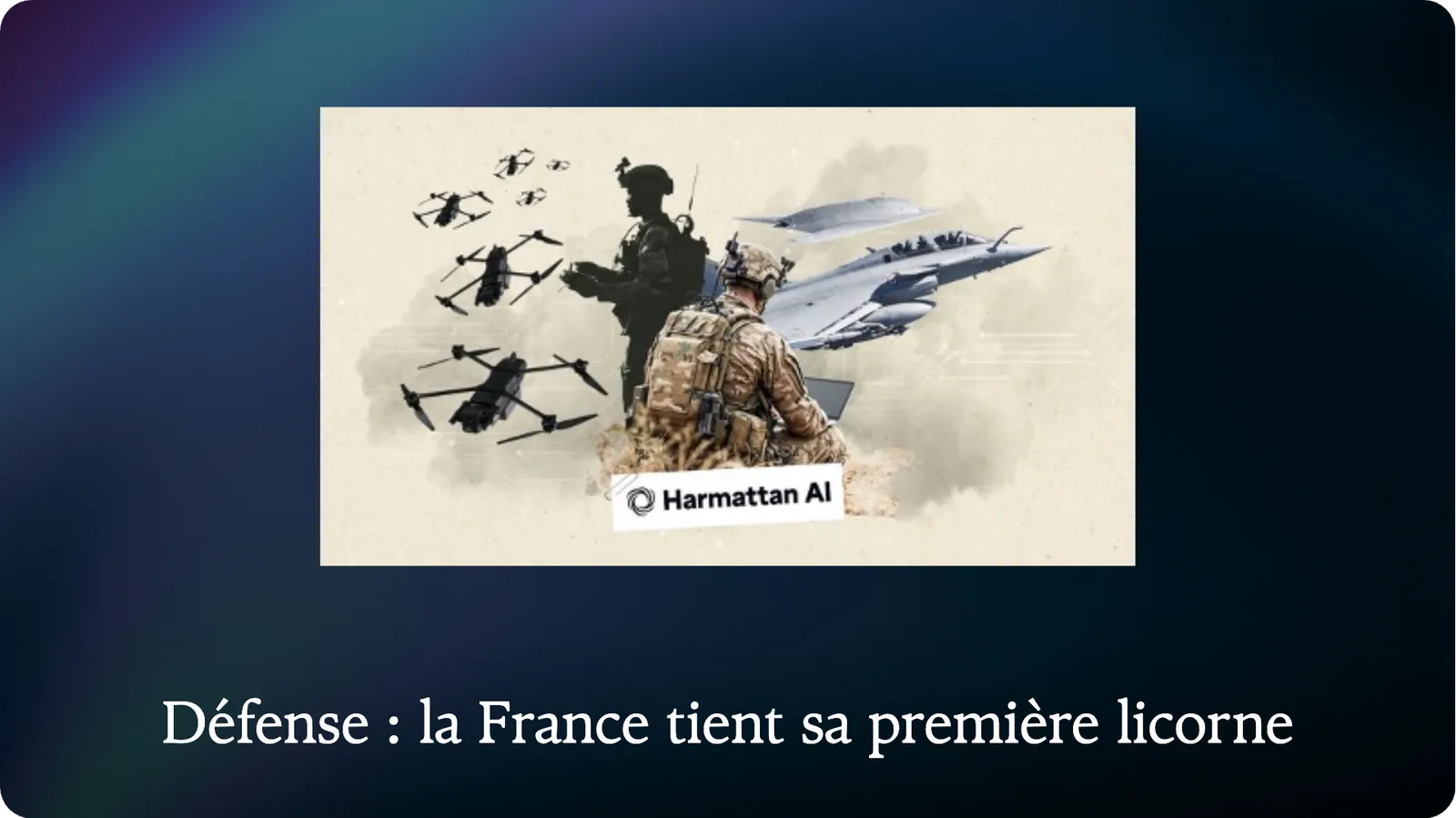
Founded in April 2024 in Paris, Harmattan AI became a unicorn on 12 January 2026. That day, the start-up announced a 200 million dollar Series B round led by Dassault Aviation, valuing it at 1.4 billion dollars, reports Maddyness. FrenchWeb converts the round to 171 million euros. Defense News presents it as France's first unicorn in the defence sector, less than two years after its creation.
The deal goes beyond a simple equity stake. Dassault Aviation and Harmattan AI are entering a strategic partnership to develop the onboard artificial intelligence of the aircraft manufacturer's future air combat systems, including the future F5 standard of the Rafale and the combat drone intended to accompany it as an uncrewed wingman, according to Defense News. "Dassault Aviation's trust accelerates our mission: to provide sovereign and scalable AI to allied forces," said Mouad M'Ghari, co-founder and CEO of the start-up, quoted by Maddyness. On X, Emmanuel Macron hailed excellent news for strategic autonomy and for the armed forces' technological superiority in AI-enabled defence drones, and described the partnership as essential.
A rise in less than two years
Harmattan AI was founded by Mouad M'Ghari and Martin de Gourcuff. Its Series A had been led by the New York fund FirstMark (Maddyness); in total, the company had raised 42 million dollars from FirstMark and Atlantic VC before Dassault came in, according to Defense News, which credits it with more than 130 employees.
Its catalogue covers surveillance and reconnaissance, drone interception, electronic warfare, strike drones and command software. The first orders came quickly: the French Ministry of the Armed Forces ordered 1,000 combat drones in June 2025, and the UK Ministry of Defence up to 3,000 autonomous drones in September 2025, according to Defense News. A presentation seen by Bloomberg, reported by Presse-citron, mentions a target of 10,000 drones per month in 2026: this is a stated ambition, not an observed production rate.
Why an aircraft manufacturer invests in a start-up
For Dassault Aviation, the aim is to quickly acquire software expertise (autonomy, sensor fusion, drone coordination) that major prime contractors traditionally develop over long cycles. Éric Trappier, its CEO, explained that the investment strengthens the group's ability to deliver the advanced capabilities armed forces will need in the coming decades. The context matters: the European Future Combat Air System programme, run with Germany and Spain, remains stalled by disagreements over work-sharing between Dassault and Airbus, notes Defense News.
The deal illustrates a broader movement: established defence manufacturers are taking stakes in young autonomy and AI companies rather than competing with them. For the French ecosystem, it is also a signal that a defence start-up can reach a billion-dollar valuation without leaving the country.
What is at stake for companies
For suppliers, mass production of drones changes the scale of requirements: optronics, electronic components, batteries, data links. Defense News cites, for example, the Lynred infrared cameras fitted to one of the company's quadcopters. For competing manufacturers, the arrival of players able to deliver within a few months reshuffles the cards in tenders. For investors, the round confirms the appetite for dual-use technologies, provided public orders follow.
What monitoring teams should watch
- Public orders: notifications from the DGA (French defence procurement agency) and the UK Ministry of Defence, and the move from demonstration batches to recurring volumes.
- Milestones for the Rafale F5 and the wingman drone, which will show whether Harmattan AI's AI is actually integrated into Dassault Aviation's programmes.
- Upcoming funding rounds and manufacturers taking stakes in other defence start-ups, a sign of a reshaping of the industrial base.
- The supply chain for sensors, components and batteries, whose availability determines the production rate target.
- The regulatory and ethical debate on the autonomy of weapon systems, in France and at European level.
Our guide to press monitoring in the defence sector and the BITD explains how to organise this tracking, and our guide to technology monitoring shows how to spot disruptions driven by start-ups early. NewsCore also supports players in the defence industry.
Sources
- Maddyness, Défense : Harmattan AI devient une licorne avec un tour de table de 200 millions de dollars mené par Dassault Aviation (2026)
- Defense News, Dassault Aviation invests in Harmattan AI at $1.4 billion value (2026)
- FrenchWeb, Harmattan AI ouvre son capital à Dassault Aviation lors d’une série B de 171 millions d’euros (2026)
- Presse-citron, Les 3 choses à savoir sur Harmattan AI, la nouvelle licorne française de la défense (2026)
Go deeper
All reportsThree NewsCore reports that build on this article.
- ID : NSC/DEF/0005 · Window 12 months
Defense-tech emergence, funding, Rheinmetall-Anduril partnership and new EU entrants.
€6,500Request - ID : NSC/DEF/0013 · Window 1 month
NIST PQC, EU programmes, quantum sensors, QKD communications and threats to critical infrastructure.
€7,500Request - ID : NSC/DEF/0019
Franco-German-Spanish FCAS and UK-Italian-Japanese GCAP programmes: structure, timeline, export prospects.
€7,500Request