

COP29: Climate Promises, Political Realities
COP29 secured a 300 billion dollar annual fund from 2026 and renewable targets, but a fossil fuel phase-out remains blocked.
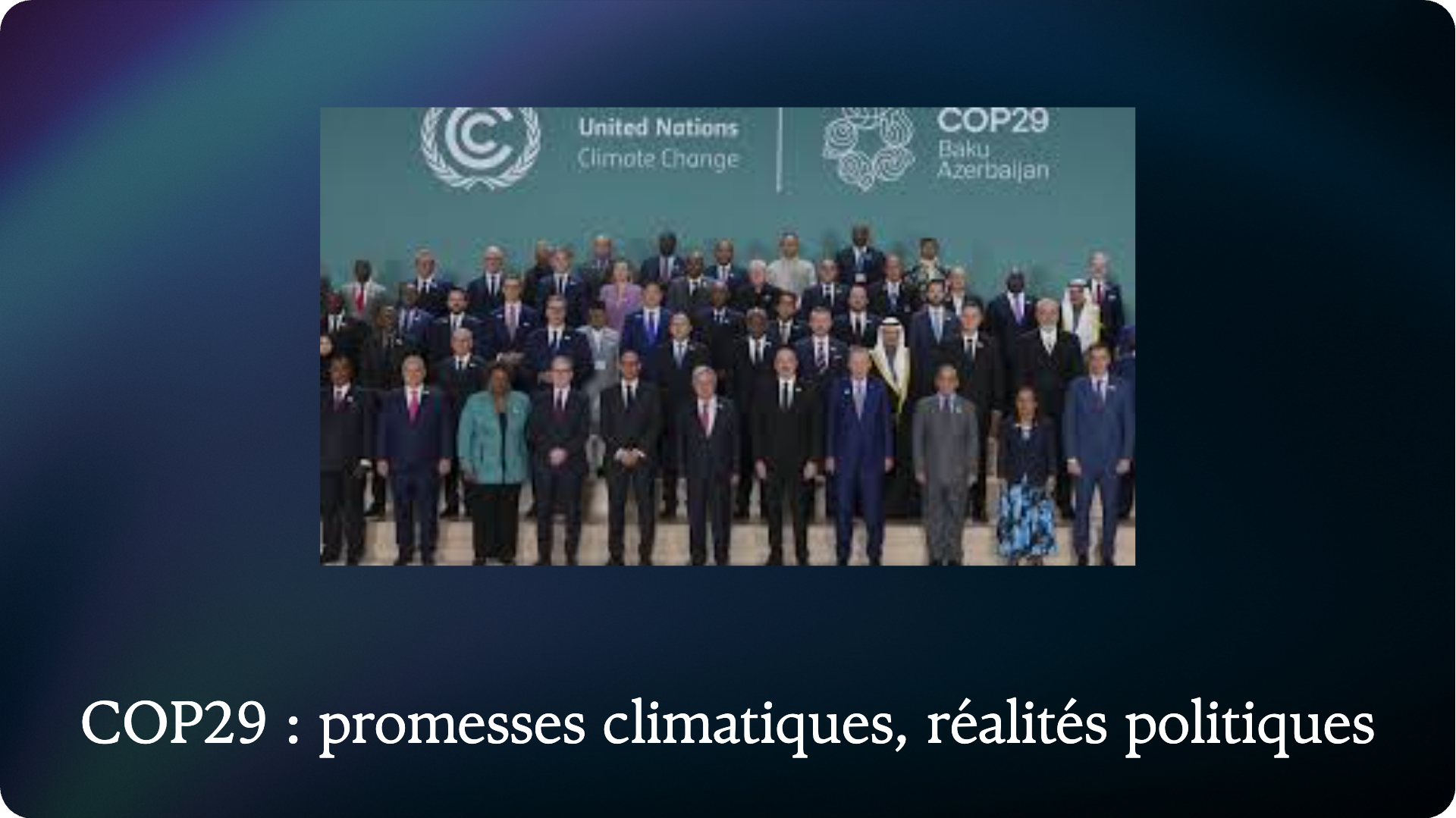
The 29th Conference of the Parties, or COP 29, was held this year in Baku, Azerbaijan, from November 4 to 22, 2024. It builds on COP 21 and the Paris Agreement, against a backdrop of an increasingly pressing climate emergency. Here is a look back at a month of negotiation mixing climate and social urgency with economic pragmatism.
In 2015, the Paris Agreement was meant to limit global warming to 2°C compared with pre-industrial levels. Almost 10 years later, the signatories face a cold shower, after disappointing results and broken promises from economies that rely on polluting resources for their growth. This year, 198 delegations are present. The optimism of 2015 has given way to the reality of 2024 and the cry for help from indigenous peoples of the Pacific, Amazon and Arctic Circle, led by the Marshall Islands. This edition was even marked by the presence of grassroots and social movements such as Fridays For Future, led by Greta Thunberg. Expectations were therefore enormous, equal to the hopes of 2015. What about the answers?
This COP enabled a step forward that must be treated with caution. First, the climate fund for adaptation, losses and damages suffered by nations will be endowed with a joint commitment of 300 billion dollars per year starting in 2026. This fund will initially be dedicated to island nations, which have no means of survival other than exodus. Then, the COP 29 plan on renewable energies was meant to be ambitious: tripling renewable energy capacity compared with 2019, reducing dependence on fossil fuels, and finally an energy efficiency plan aimed at reducing industrial energy consumption by 30% by 2030. To ensure the viability of these efforts, two ideas were put forward. First, requiring multinationals from party countries to publish annual transparency reports on their carbon footprint. Second, facilitating cooperation between European, African and Indian subcontinent countries in order to create green corridors in the most demanding areas. But while these objectives seem laudable, does the Baku agreement live up to them?
The verdict is unanimous: this conference leaves a bitter aftertaste for everyone. The question of a gradual exit from fossil fuel energy sparked indignation and opposition from Russia, China and Saudi Arabia. Since each one depends on gas, coal or oil for its economy, none wish to lose its place in the global economy. Only support for transition gas will be mentioned; the rest will not, in the end, be targeted by exit measures. Next, the responsibility of rich countries towards poor countries. For poorer nations, climate damage is directly attributable to the richest, who benefited massively, and they therefore demand a greater investment from them. The fund being one way to address this, it was at the heart of the extra negotiating time.
These 300 billion dollars obtained at the wire ultimately satisfied no one. In France, the result is judged "not up to the task" and "disappointing" according to Agnès Pannier-Runacher, Minister for the Ecological Transition. The states of the Global South, led by India and hoping for 1,000 billion euros to subsidise the transition to low-carbon energy, denounce an agreement "too weak" according to the African group and see it as a "painful experience" according to the Brazilian Minister for the Environment, Marina Silva.
Finally, the traceability of the agreements has been called into question. How can compliance with measures be ensured in the absence of clear and unambiguous sanction mechanisms? The agreements cannot rely on voluntary compliance by each nation with binding measures.
Sources:
Go deeper
All reportsThree NewsCore reports that build on this article.