

Investments for the Choose France summit
The Choose France summit of 19 May 2025 announced 37 billion euros of investment, including 20 billion for entirely new projects, led by artificial intelligence and data centres.
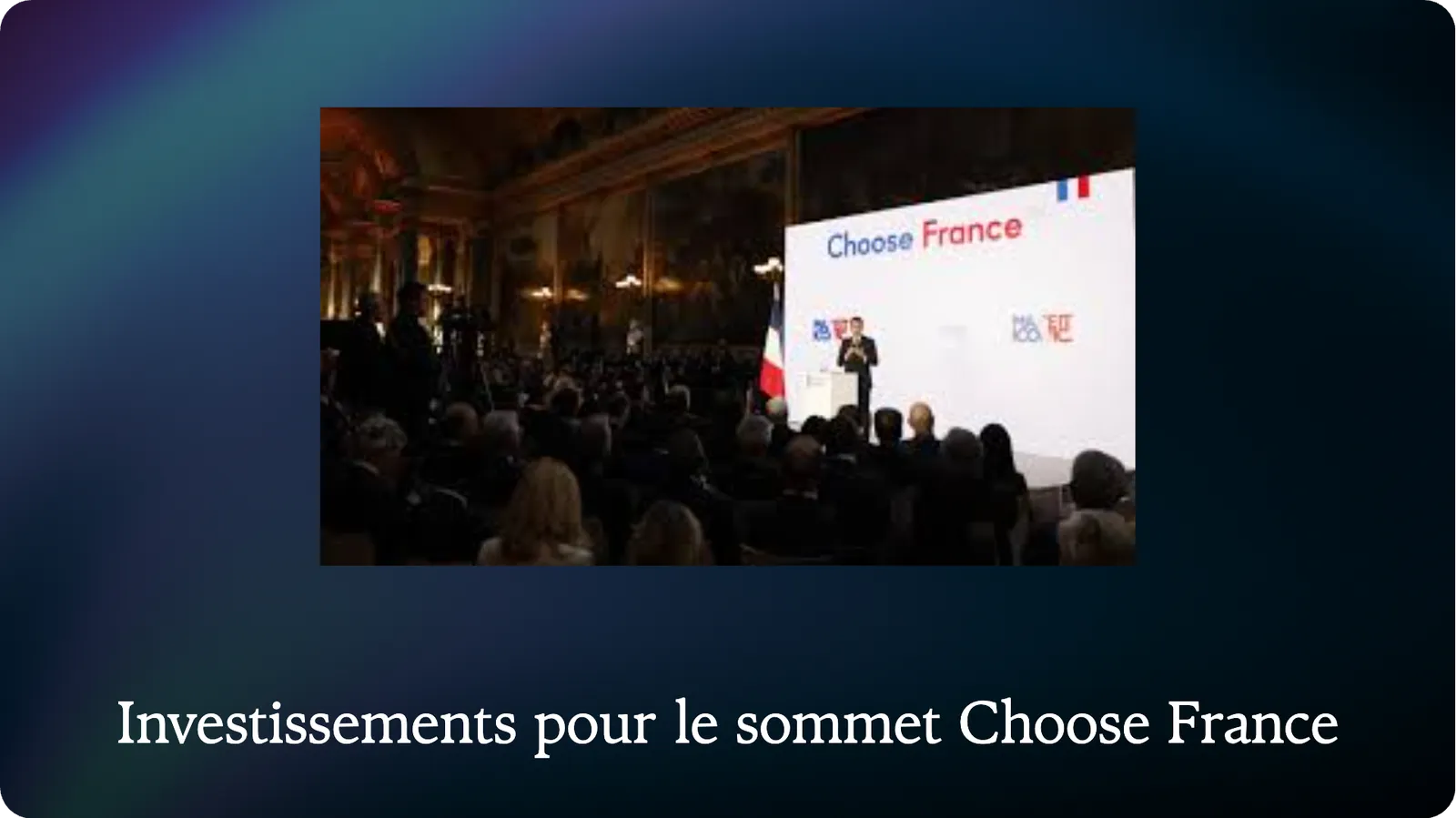
On Monday 19 May 2025, Emmanuel Macron hosted the eighth edition of the Choose France summit at the Palace of Versailles, an annual event designed to attract foreign investors. According to the Élysée, quoted by L'Info Durable, 37 billion euros of investment were announced, including 20 billion for entirely new projects. The presidency speaks of a record, the 2024 edition having reached 15 billion euros. A look back at a summit heavily focused on artificial intelligence, and at what really matters.
A record to be read with caution
The 37 billion euro figure adds up two kinds of announcements. The 20 billion of new projects is the genuinely new part. The remaining 17 billion corresponds, again according to the Élysée, to projects already presented at the Artificial Intelligence Action Summit in February 2025 and now located in France. The final count reported by L'Info Durable actually mentions 40.8 billion euros, which shows that the scope varies depending on the date and counting method. The whole package is expected to create around 13,000 direct or indirect jobs.
The summit builds on a favourable context measured by the EY 2025 attractiveness survey: with 1,025 projects announced by foreign investors in 2024, France keeps first place in Europe for the sixth consecutive year. The same survey, however, qualifies this ranking: in terms of jobs created, France comes only third, and ninth for the number of jobs per project.
Artificial intelligence and data centres lead the way
Most of the largest amounts concern digital infrastructure. Among the announcements listed:
- Prologis (United States): 6.4 billion euros for logistics warehouses and four data centres in the Île-de-France region;
- MGX (United Arab Emirates), with Bpifrance, Mistral AI and Nvidia: a first tranche of 8.5 billion euros for an artificial intelligence campus in Île-de-France, expected in 2028;
- Brookfield (Canada): 10 billion euros for a data centre site in Cambrai, confirming an announcement made in February;
- Digital Realty (United States): 2.3 billion euros confirmed for data centres in Marseille and Dugny (Seine-Saint-Denis).
Other sectors are represented. Revolut plans 1 billion euros over three years and is setting up its Western European headquarters in Paris; the Saudi sovereign wealth fund PIF is opening a Paris office; Amazon announces more than 300 million euros and more than 1,500 jobs; MSC Cruises confirms around 3.5 billion euros for two cruise ships built in Saint-Nazaire. Part of these amounts therefore reflects the confirmation or sequencing of projects already known, which any analysis must distinguish from additional investment.
A political summit too
The summit served as a regulatory platform. According to L'Info Durable, Emmanuel Macron called there for the repeal of the European directive on corporate sustainability due diligence (CS3D), rather than its mere postponement, in the name of simplification and competitiveness against American and Chinese rivals. This stance drew strong reactions from NGOs and trade unions, and it directly concerns the groups that have built their compliance systems around this text.
What is at stake for companies
For a large group, Choose France is not just an image event. The announcements redraw the map of computing capacity, available energy and industrial land. The arrival of high-capacity data centre campuses weighs on grid connections, land prices and the skilled labour market in the areas concerned. It also creates opportunities for suppliers (construction, cooling, energy, security) and changes the competitive landscape of cloud players. Finally, the gap between announced and actually committed amounts means each project must be tracked over time: the real impact will only be measurable over several years.
What monitoring teams should watch
- How projects materialise: building permits, grid connections, first hires and commissioning schedules, project by project.
- Revisions of amounts: tranches confirmed, postponed or abandoned, especially for the artificial intelligence campuses announced in several stages.
- The arrival of new entrants in your sector (sovereign wealth funds, data centre operators, neobanks), to be included in your competitive intelligence on new entrants.
- The fate of the due diligence directive in the European simplification process, to be tracked through structured regulatory monitoring.
- The attractiveness indicators published each year (EY survey, official reports), useful for economic monitoring of foreign investment.
NewsCore tracks these signals continuously across tens of thousands of multilingual sources and links them to the right event, so that management teams have an up-to-date status of each announcement rather than an isolated press release.
Sources
- L'Info Durable, Choose France : 37 milliards d'euros d'investissements annoncés lundi, dont 20 milliards entièrement nouveaux (2025)
- L'Info Durable, Choose France : les principales annonces du sommet (2025)
- EY, Baromètre EY de l'attractivité de la France 2025 (2025)
- L'Info Durable, Macron demande la suppression de la directive sur le devoir de vigilance (2025)
Go deeper
All reportsThree NewsCore reports that build on this article.
- Generative AI Chips: A $500B MarketBest sellerID : NSC/TECH/0001 · Window 12 months
Nvidia Blackwell, AMD MI300X, Google TPU v6, AWS Trainium2; AI chip revenue approaching $500B in 2026.
€7,500Request - ID : NSC/TECH/0005 · Window 6 months
Salesforce Agentforce, Microsoft Copilot, Anthropic Claude, Mistral agents: adoption and ROI.
€7,000Request - ID : NSC/DEF/0020 · Window 3 months
NGSW XM7/XM250, FAMAS replacement HK416 F, FELIN, Microsoft IVAS, exoskeletons and wearable sensors.
€6,000Request