

China's Trade Surplus
China's trade surplus tops $1 trillion in 2025, revealing rising dependence on exports as domestic demand keeps weakening.
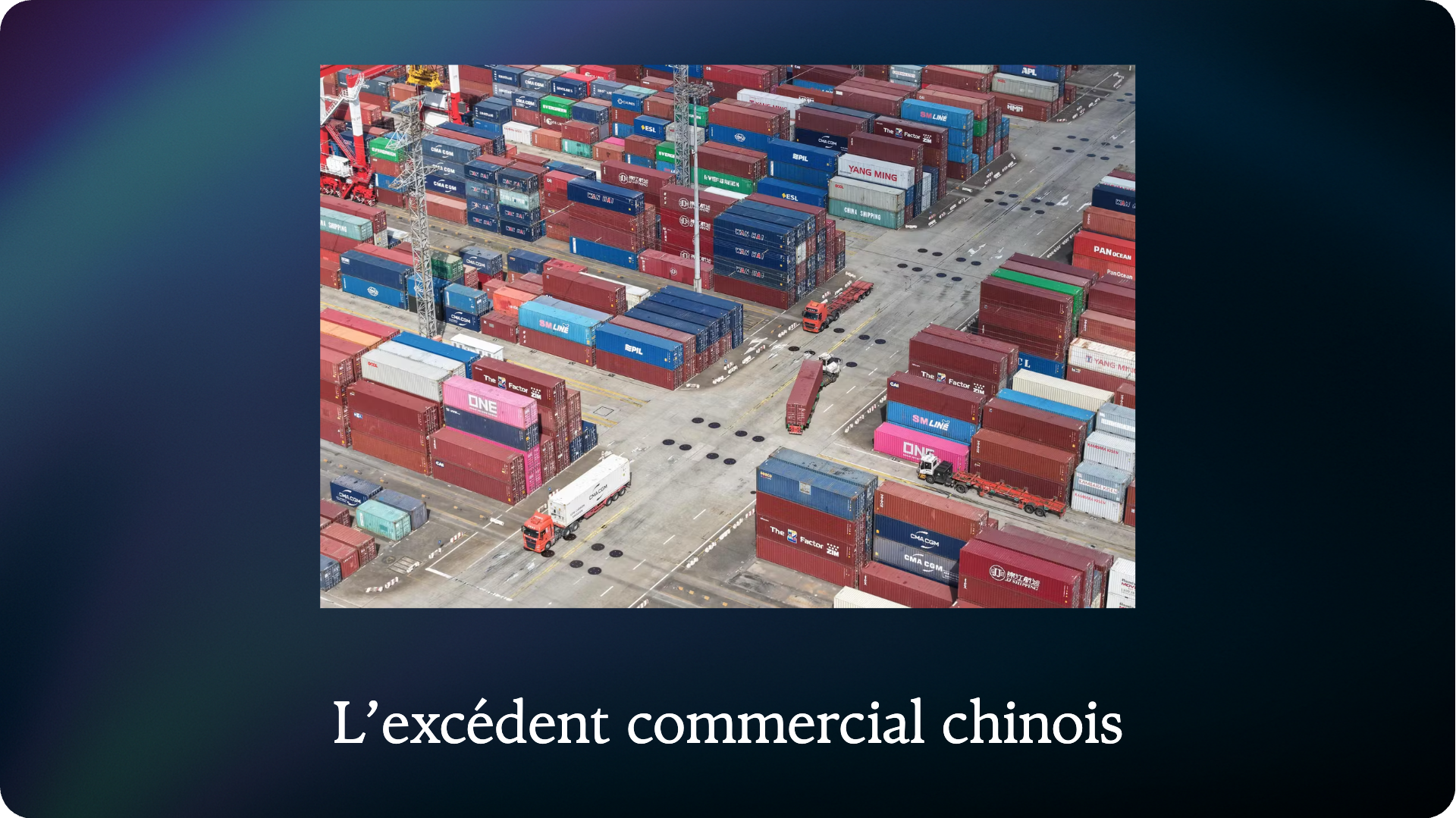
In 2025, China's trade balance crossed a historic threshold that says a great deal about the real state of its economy. For the first time, its trade surplus exceeded 1,000 billion dollars. More precisely, it was estimated at 1,080 billion dollars from January to November 2025. According to other estimates, it could reach close to 1,200 billion dollars for the whole of 2025. This unprecedented record in contemporary economic history places Beijing at the center of global imbalances and confirms a profound shift in its growth model. Behind this striking figure lies a more complex reality. The surplus is not a sign of domestic prosperity but rather of an economy increasingly dependent on exports to compensate for the weakening of its domestic demand. China today exports far more than it imports, not out of internal dynamism, but out of strategic necessity.
A surplus that reveals a model under strain
For several years, the Chinese economy has been facing a double shock. Externally, the trade relationship with the United States has entered a phase of structural confrontation. Internally, consumption is slowing, youth unemployment remains high, and the real estate sector, the historic pillar of growth, is going through a deep crisis. At the same time, the Chinese domestic economy is struggling to recover an autonomous engine of growth. Consumption is not progressing. Households, faced with economic uncertainty and the deterioration of the value of their real estate assets, are favoring savings. Moreover, youth unemployment fuels a lasting distrust toward the future: according to the National Bureau of Statistics of China, the youth unemployment rate in China stood at 16.5% in December 2025. Imports of consumer goods are declining, reflecting structurally weakened domestic demand.
The real estate sector, which still represented more than 7% of GDP in 2024, remains the main threat. Residential investment is collapsing, sales of new housing are falling, and major companies in the sector continue to struggle with repeated liquidity crises. For example, according to the International Monetary Fund, the ratio of household debt to GDP in China tripled between 2008 and 2023, rising from less than 20% to more than 60% of GDP, which shows the massive accumulation of debt linked to the real estate market even before the current slowdown. Real estate is at once a driver of activity, a pillar of household savings, and a foundation for the financing of local governments. Its weakening undermines the entire Chinese economy.
Faced with this faltering domestic demand, Chinese companies are unloading their industrial overcapacity abroad. In November 2025, Chinese exports rose by 5.9% year-on-year while imports increased by only 1.9% over the same period. This concerns the automotive sector but also batteries, solar panels, electrical equipment, and industrial machinery. China produces far more than it consumes. The trade surplus thus becomes a mechanism of macroeconomic stabilization, a safety valve for a growth model under strain.
The American trade war as a catalyst
To understand this shift, it is necessary to factor in the geopolitical dimension of the Sino-American relationship. Since 2018, the United States has progressively turned trade into an instrument of national security. Tariffs and export controls no longer aim merely to correct a trade deficit but to contain China's technological rise. In 2025, the nearly 29% drop in Chinese exports to the United States reflects the partial effectiveness of this decoupling strategy. However, it also reveals Beijing's adaptability. In just a few years, China has redirected its flows toward areas less exposed to American sanctions, notably Southeast Asia. For example, ASEAN has become its leading trading partner. Trade with Vietnam, Thailand, and Malaysia is booming, particularly in electronic components and industrial equipment. These flows rose by 8% in November and December 2025. These countries now act as an industrial hub allowing Chinese companies to bypass part of the American barriers. Ultimately, value chains do not disappear; they relocate.
Europe at the heart of the commercial battlefield
The European Union has become one of the main theaters of Chinese industrial overproduction. For example, in 2025, Chinese exports to the EU grew by approximately 14.8%. Chinese products (electric vehicles, batteries, solar panels, machine tools, etc.) are rapidly gaining ground in the European market, driven by highly competitive prices and a technological upgrading that is now undeniable. This dynamic is fueling growing concern in Brussels. The European Commission has opened several anti-subsidy investigations, particularly in the automotive sector, fearing what it considers unfair competition. The debate over the end of free trade is gaining ground.
The monetary question must also be taken into account. Many analysts believe that the yuan remains structurally undervalued, giving Chinese industry a massive competitive advantage. The People's Bank of China regularly intervenes to stabilize the currency, but Beijing refuses any sharp appreciation that would penalize its exporters. The exchange rate thus becomes a fully fledged industrial policy instrument.
The joint visit of Emmanuel Macron and the German Chancellor to Beijing illustrates this European ambivalence. The European Union seeks to preserve access to the Chinese market while attempting to contain an industrial surge likely to weaken its own production capabilities. Behind economic diplomacy, a battle is being fought for the survival of certain strategic sectors.
The Global South: a new frontier for Chinese expansion
Beyond the major trading powers, China's trade surplus is also reshaping the balance of the Global South. India is seeing its trade deficit with Beijing widen dangerously, fueling its industrial dependence. Despite its reindustrialization ambitions, New Delhi remains heavily dependent on Chinese machinery and components. Southeast Asia is emerging as a central pivot of China's commercial strategy. Vietnam, Thailand, and Malaysia play a key role in the transformation and re-export of Chinese products to Western markets. ASEAN is now China's leading trading partner, ahead of the European Union and the United States. In many emerging economies, China is establishing itself as an essential industrial supplier, strengthening its economic and political influence. The surplus thus becomes an economic weapon for China in developing countries.
What strategic interests for France and the European Union?
The Chinese trade surplus of more than 1,000 billion dollars is not a mere statistical performance. It is a signal, almost a warning light. It reveals a Chinese economy increasingly oriented toward exports to compensate for its internal fragilities. It also shows an industry now capable of competing head-on with Western economies in the technologies of the future. China has turned its exchange rate and trade surplus into economic weapons.
For France, the issue is particularly sensitive. China remains an essential market for aeronautics, luxury goods, agri-food, and services. However, it is also a formidable competitor in strategic industrial sectors such as electric vehicles, batteries, renewable energies, and industrial equipment. The question is therefore no longer whether to trade with China, but on what terms. Preserving balanced access to the Chinese market must be accompanied by a genuine policy to protect European industrial capacities.
In a world where trade is once again becoming a battlefield, the Chinese surplus appears less as an economic success than as a symptom of globalization entering a new era of geoeconomic confrontation.
SOURCES:
China Balance of Trade. China balance of Trade. (n.d.). https://tradingeconomics.com/china/balance-of-trade
Comment la Chine l'a emporté. France Culture. (2025, December 11). https://www.radiofrance.fr/franceculture/podcasts/l-invite-e-des-matins/l-invite-e-des-matins-emission-du-jeudi-11-decembre-2025-6528074
Direction générale du Trésor. (2025, January 13). Brèves économiques Chine & Mongolie: Semaine du 13 janvier 2025. Ministère de l'Économie, des Finances et de la Souveraineté Industrielle et Numérique. https://www.tresor.economie.gouv.fr/Articles/48720c09-22c4-429a-8d60-6827ae4d05e3/files/dc8a52c5-67bf-4e2c-b8cb-6e6770a706a1
Force, A. P. T. (2025, December 15). China's $1 trillion trade surplus and global imbalance. Beyond the Horizon ISSG. https://behorizon.org/chinas-1t-trade-surplus-and-global-imbalances/
FRANCE 24. (2025, December 8). L'excédent commercial de la Chine dépasse pour la première fois 1 000 milliards de dollars. France 24. https://www.france24.com/fr/info-en-continu/20251208-chine-l-exc%C3%A9dent-commercial-d%C3%A9passe-1-000-milliards-de-dollars-en-2025
Kozul-Wright, A. (2025, December 9). How did China's trade surplus hit $1 trillion? Al Jazeera. https://www.aljazeera.com/news/2025/12/9/how-did-chinas-trade-surplus-hit-1-trillion
Kynge, J. (2025, December 8). China's record $1 trillion-plus trade surplus shows the renminbi should be allowed to appreciate. Chatham House. https://www.chathamhouse.org/2025/12/chinas-record-1-trillion-plus-trade-surplus-shows-renminbi-should-be-allowed-appreciate
Netpublic. (2025, December 8). L'excédent commercial de la Chine dépasse les 1 000 milliards de dollars en 2025, un record. Netpublic.fr. https://www.netpublic.fr/blog/lexcedent-commercial-de-la-chine-depasse-les-1-000-milliards-de-dollars-en-2025-un-record/
Reuters. (2025, December 8). China's trade surplus passes $1 trillion for the first time thanks to non-US growth. Zonebourse Suisse. https://ch.zonebourse.com/actualite-bourse/l-excedent-commercial-de-la-chine-depasse-pour-la-premiere-fois-1-000-milliards-de-dollars-grace-a-l-ce7d51ddd08ef42d
Rogoff, K., & Yang, Y. (2024, December 10). China: The Real Estate Challenge. IMF. https://www.imf.org/fr/publications/fandd/issues/2024/12/chinas-real-estate-challenge-kenneth-rogoff
China youth unemployment rate 2021-2025 data: 2026-2028 forecast. https://fr.tradingeconomics.com/china/youth-unemployment-rate
Go deeper
All reportsThree NewsCore reports that build on this article.
- ID : NSC/AUTO/0014 · Window 3 months
Chery, Great Wall, Geely: market share gains in Russia, Brazil, MENA and local plant strategies.
€6,000Request - ID : NSC/TRSP/0012
Mexico post-USMCA, Poland, Romania, Morocco: production flows shifting out of China.
€7,000Request - ID : NSC/BFSI/0011
Apollo, Blackstone, Ares, KKR: private credit growth, LBO refinancing and VC decline.
€7,500Request