

Black Sea: insurance and oil under pressure
After drone attacks on two tankers near the Caspian Pipeline Consortium terminal, Black Sea war risk insurance premiums are climbing to about 1% of vessel value. The CPC corridor, vital for Kazakh oil, is becoming a point of fragility for European refiners.
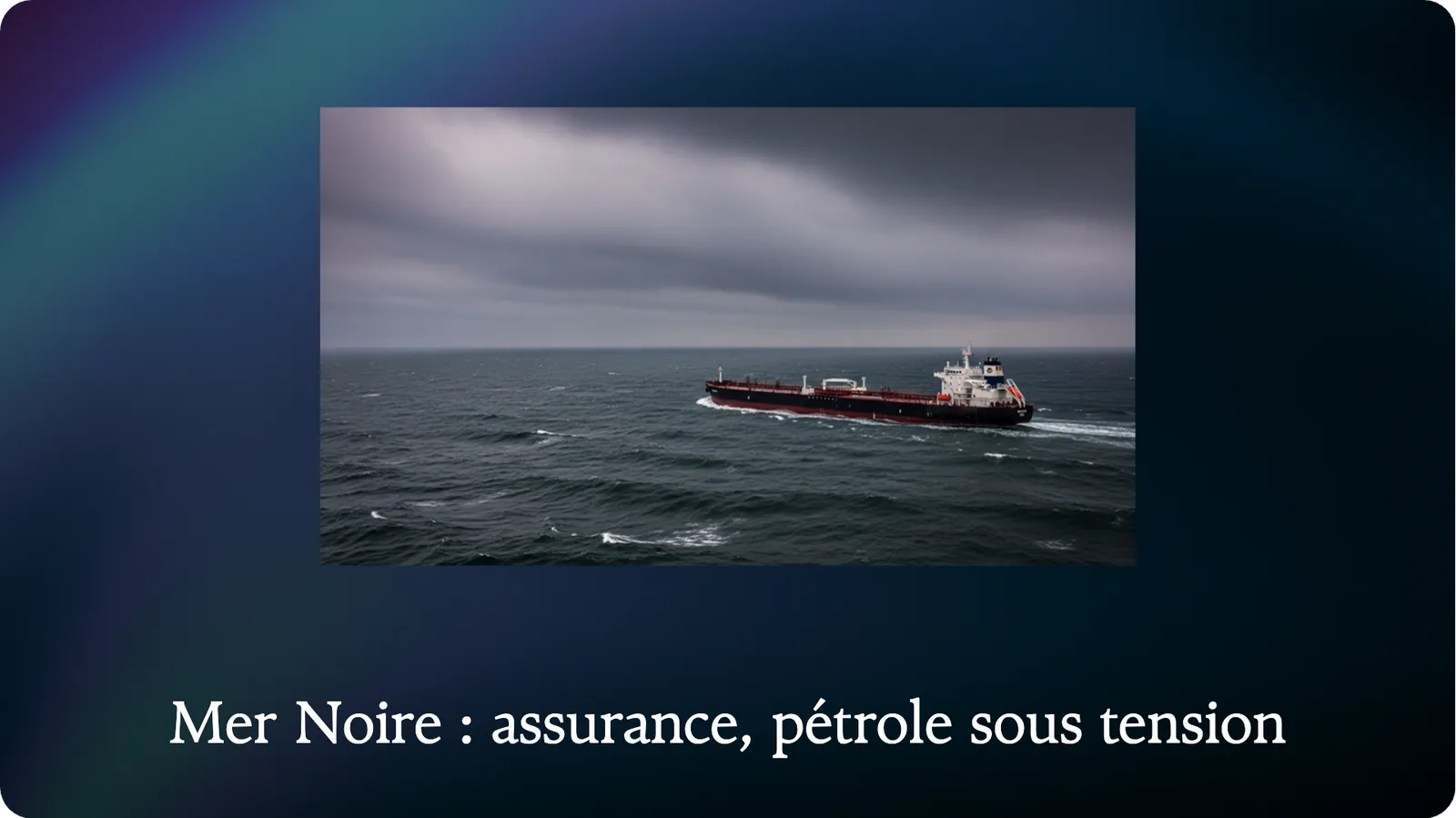
On January 13, two tankers managed by Greek shipowners were hit by drones while heading to the Caspian Pipeline Consortium (CPC) terminal, on Russia's Black Sea coast, to load crude. According to The Maritime Executive, the vessels were the Matilda and the Delta Harmony, both sailing in ballast; one of them was chartered by Chevron. Deck damage remained limited and no injuries were reported, but the incident marks a turning point: the same outlet notes that strikes had until then spared tankers compliant with sanctions.
Premiums reviewed every 24 hours
Insurers reacted immediately. War risk premiums for calls at Black Sea terminals rose to about 1% of the vessel's value, up from 0.6 to 0.8% at the end of December, reports Baird Maritime, citing Reuters. More worrying still, these terms are now reviewed every 24 hours, compared with 48 hours the previous month, reflecting strong market nervousness and constant reassessment of the risk. For a recent Suezmax, war risk cover alone can reach $800,000 per voyage, according to Bloomberg figures cited by The Maritime Executive.
The CPC, artery of Kazakh oil
The stakes go well beyond these two incidents. The targeted terminal loads about 80% of the Kazakh oil bound for international markets, and the CPC pipeline carries more than 1% of global supply, according to Baird Maritime. The corridor was already weakened: in early December 2025, a drone attack damaged a mooring buoy near Novorossiysk, forcing the terminal to operate with a single loading point instead of two, and Kazakh oil and condensate output fell by 6% over the first two days of the month. Any disruption on this corridor therefore has repercussions far beyond the region.
What this changes for Europe
For Europe and France, the consequences are tangible. Rising insurance premiums mechanically push up freight costs and make insurers and shipping operators more cautious, with some shipowners possibly giving up on serving the area. This uncertainty complicates supply planning and creates a risk of tension on CPC Blend, a crude closely tracked by several European refiners.
What is at stake for businesses
For refiners, traders and manufacturers dependent on these flows, three risks add up: a physical risk (interrupted loadings), a cost risk (premiums, demurrage, freight) and a contractual risk (force majeure clauses, delivery delays). For insurers and brokers, the daily review of terms requires up-to-date, hour-by-hour information on incidents in the Black Sea. Shipowners, for their part, must weigh their crews' exposure against keeping their contracts.
What monitoring teams should watch
- Incidents targeting the Novorossiysk and CPC terminals, and the status of available mooring points.
- War risk premium levels and how often they are reviewed, leading indicators of freight costs in the area.
- CPC Blend loading volumes announced each month and the trend in Kazakh output.
- Flag state security guidance and designations targeting vessels or operators, to be built into international sanctions monitoring and geopolitical country risk monitoring.
- The exposure of carriers and crude suppliers to the corridor, to be reassessed when tracking supplier and third-party risks.
Sources
- Baird Maritime (Reuters), Drone attacks push Black Sea war insurance rates higher for oil tankers (2026)
- The Maritime Executive, Russian and Ukrainian strikes are raising war risk insurance costs (2026)
- Baird Maritime (Reuters), Kazakhstan's oil output slumps as exports curbed by damaged terminal (2025)
Go deeper
All reportsThree NewsCore reports that build on this article.
- ID : NSC/ENER/0017 · Window 12 months
Net-zero target retreats, upstream capex, integrated power and low-carbon strategies.
€7,000Request - ID : NSC/ENER/0018
OPEC+ discipline, US shale rebound, Guyana, Brazil and Asian post-peak demand.
€6,500Request - ID : NSC/AUTO/0011 · Window 1 month
BYD Hungary plant, EU countervailing duties, Atto 3, Seal U, Dolphin lineup and Stellantis-Renault impact.
€7,500Request