

ArcelorMittal: nationalization sparks debate
Adopted by the National Assembly in November 2025 and again at second reading in June 2026, rejected by the Senate in February, LFI's bill to nationalize ArcelorMittal France revives the debate on industrial sovereignty and employment.
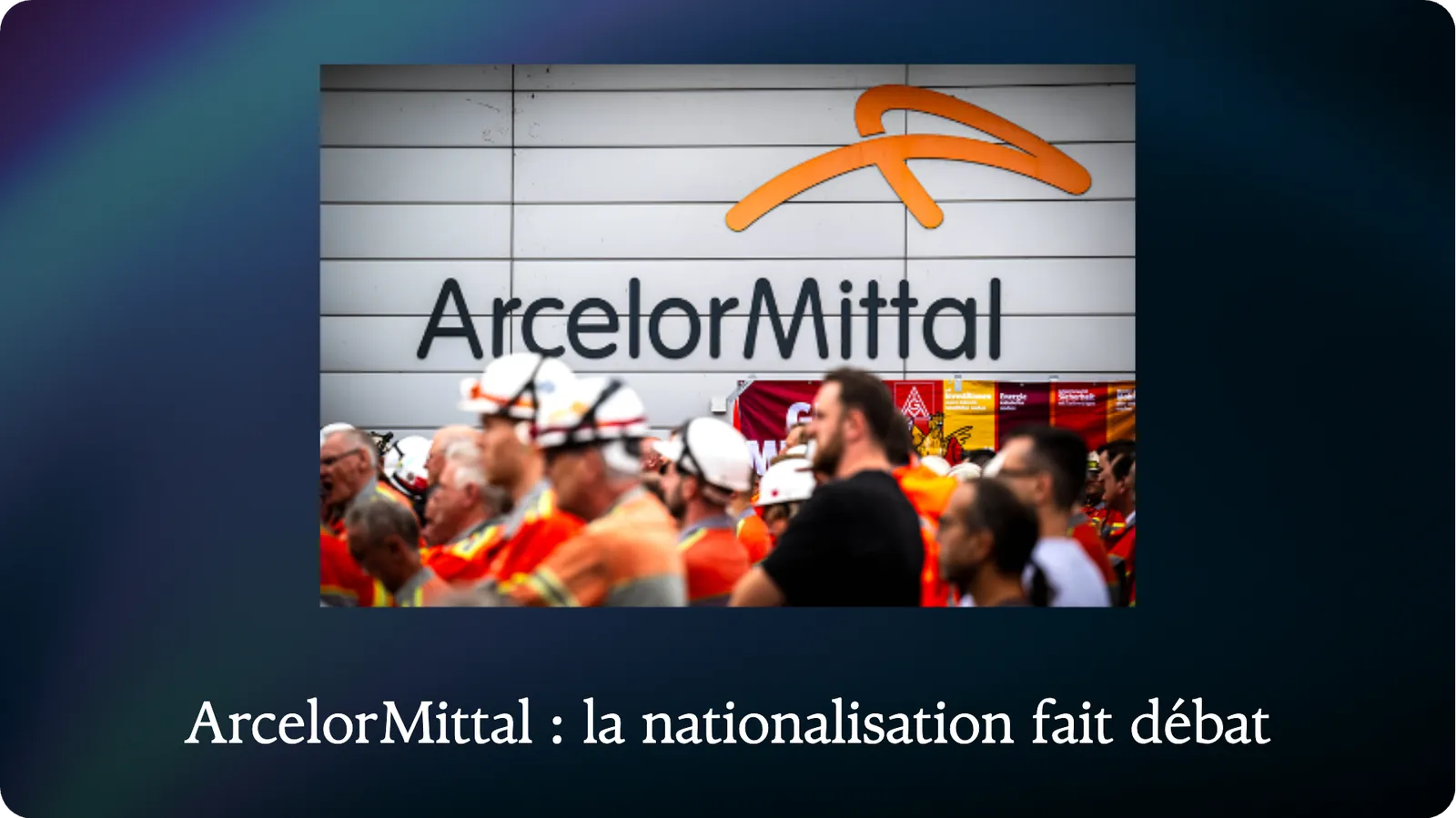
During the night of November 27 to 28, 2025, the French National Assembly adopted at first reading La France insoumise's bill to nationalize ArcelorMittal France, by 127 votes to 41, according to LCP. The text covers all of the steelmaker's French operations, including the Dunkirk and Fos-sur-Mer steelworks. The vote revived a long-standing debate on industrial sovereignty, employment and the role of the State as shareholder, and the file has since gone through several parliamentary stages.
What was voted, and what followed
Article 1 of the text provides for the transfer to the State, in full ownership, of the shares making up the capital of ArcelorMittal France. The rapporteur, Aurélie Trouvé (LFI), estimated the cost at around 3 billion euros; a Rassemblement national deputy put forward a figure of 4 billion. The left-wing groups voted in favor, the government and the groups supporting it against, and the RN abstained, again according to LCP.
As the balance of power suggested, the Senate rejected the text on February 25, 2026, by 227 votes to 112, reports the Banque des Territoires. The Minister for Industry called nationalization a "decoy" there. The shuttle between the two chambers nevertheless continued: at second reading, the Assembly again adopted the bill on June 11, 2026, by 106 votes to 49 with 47 abstentions, according to public vote no. 7380 of the National Assembly. In the absence of agreement between the two chambers, the outcome of the text remains highly uncertain.
The industrial context
ArcelorMittal France has around 15,000 employees, a head office in Saint-Denis and some forty sites, including Dunkirk, Florange, Fos-sur-Mer and Montataire, according to Le Journal des entreprises. In May 2025, the group had announced the elimination of more than 600 jobs, mainly in Dunkirk and Florange, and frozen several steel decarbonization projects in Dunkirk.
The government shares the diagnosis on the European steel industry: weak demand, global overcapacity and high production costs in Europe. The Banque des Territoires points out that European steel demand fell by 11% between 2019 and 2024 and that the carbon border adjustment mechanism has applied since January 1, 2026. On February 10, 2026, ArcelorMittal announced a 1.3 billion euro investment in Dunkirk for an electric arc furnace, which the government presents as a sign of confidence.
The arguments on each side
Supporters of nationalization see it as the only way to guarantee the future of the sites and protect thousands of direct and indirect jobs, in a sector they consider strategic for the country's industrial independence. Opponents highlight the cost to public finances, the legal uncertainty surrounding compensation and the fact that a change of shareholder resolves neither global overproduction nor the price of energy. For the government, protecting steel is first and foremost a matter for Brussels, through safeguard measures on imports. An intermediate voice in the Senate proposes making public aid conditional on commitments regarding employment, investment and decarbonization.
What is at stake for businesses
For industrial steel customers, the file weighs on the security of supply of flat products and on the timetable for decarbonizing the steel they buy. For subcontractors and local authorities in the Dunkirk and Fos areas, it determines activity volumes and local investment. For investors, it is a reminder that political risk can affect an industrial asset in France, even when the final adoption of a text seems unlikely.
What monitoring teams should watch
- The next steps in the parliamentary shuttle and the possible scheduling of the text on the Senate's agenda: structured legislative monitoring makes it possible to follow each stage without relying solely on press headlines.
- European safeguard measures on steel and the application of the carbon border adjustment mechanism, which change the economic equation of the sites.
- ArcelorMittal's announcements on its investments (the Dunkirk electric furnace) and on any new layoff plans.
- Weak signals among suppliers and subcontractors in the steel-producing areas, to be included in supplier risk monitoring.
- Positions taken by trade unions and local politicians, which often herald shifts in the file; sector monitoring of the European steel industry helps put them in context.
Sources
- LCP, ArcelorMittal : l'Assemblée vote en faveur de la nationalisation proposée par LFI (2025)
- Le Journal des entreprises, Les députés approuvent la nationalisation d'ArcelorMittal France (2025)
- Banque des Territoires, Le Sénat rejette la proposition de loi visant à nationaliser ArcelorMittal France (2026)
- Assemblée nationale, scrutin public n° 7380 (deuxième lecture) (2026)
Go deeper
All reportsThree NewsCore reports that build on this article.
- ID : NSC/ENER/0007
H2 Green Steel, ArcelorMittal H-DRI, Vicat, Heidelberg, BASF Verbund-Ludwigshafen.
€7,500Request - ID : NSC/AERO/0020 · Window 1 month
Russian titanium substitution, carbon fiber, rare earths, circular economy and resilience post-Ukraine war.
€7,000Request - ID : NSC/AERO/0015
Cirrus Vision Jet, HondaJet, Embraer Phenom 100EX: growth dynamics and service network outlook.
€5,000Request